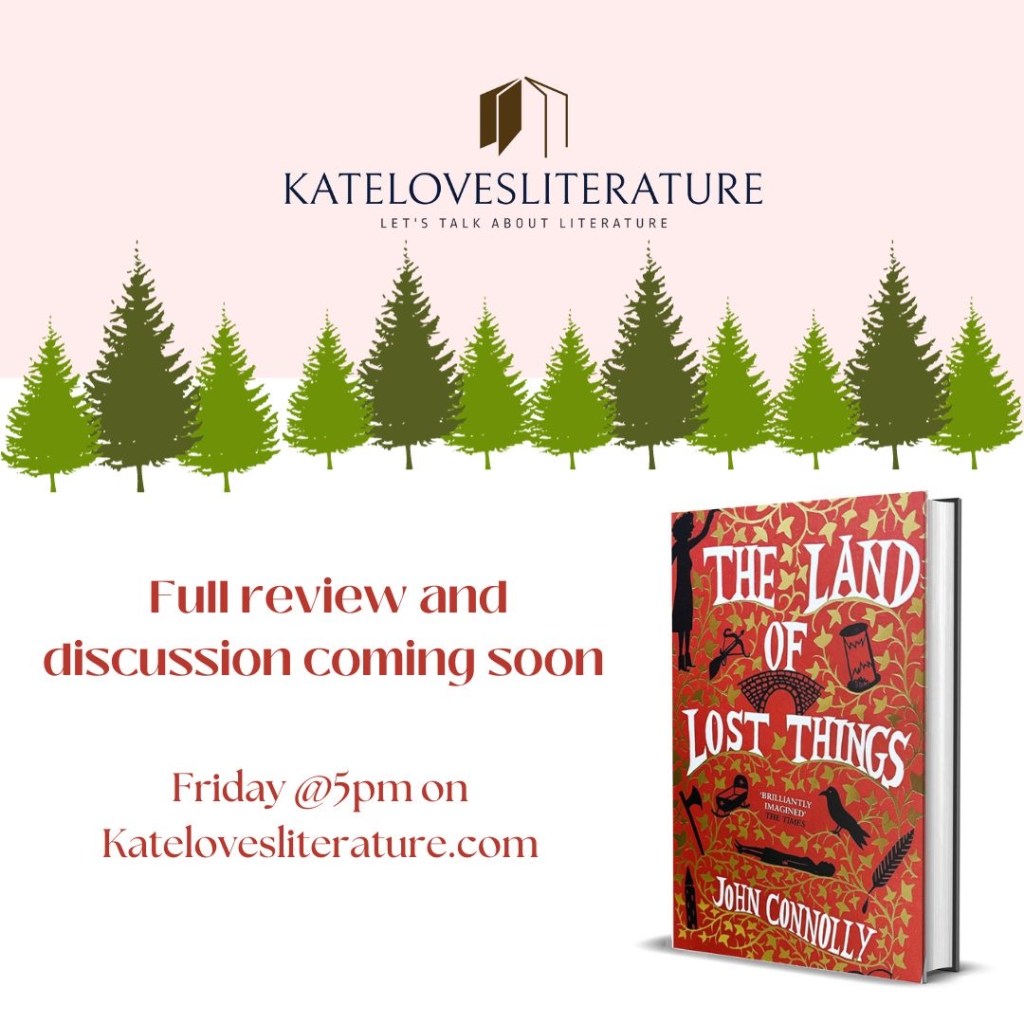
A review and discussion by Kate O’Brien.
When I read the first of this series, The Book of Lost Things, I said it was a nod to dark and twisted fairy tales, ideal for those who enjoy anything a bit Grimm. (Pardon the pun.)
I eagerly awaited Connolly’s sequel. In fact, I read this entire book in a four-hour sitting.
I was enthralled, happy to read a new tale, and happier again to see old favourites appearing once more.
I’ve taken some time to sit with this sequel, to think about it, to try to answer the famous question of which book do I prefer?
I prefer the original. Predictable, I know, but it is true. The world that John Connolly created in the first book was scary and intriguing. Poignant and emotional. Returning to it was interesting, but without the thrill of the complete unknown.
The Land of Lost Things introduces readers to a new protagonist, this time not a lost child, but the mother of a lost child. Ceres is stuck, her child Phoebe is comatose and has been since the car accident. The bright, curious child she once was is becoming more and more like a distant memory to Ceres, who fears she may never see that lively child again.
I will say now that this book, similar to the first book, contains some very sad and dark themes about sick children, about losing children, and about the grief, fear, and anger that parents carry while trying to stay hopeful. It is a sad read, so not for readers who want some lighthearted escapism.
When Ceres allows her worst fear to be uttered aloud – that perhaps things would be easier if Phoebe was out of pain, she finds herself chased into the same mysterious land that David found himself in when he wanted to escape his new life with his stepmother and stepbrother in the first book.
Ceres finds herself sixteen again and she must face her fears and find her way back home, back to her child, and she does this with the help of familiar faces. The idea of being a teenager again and how horrified Ceres is by this is very funny. It’s a really interesting concept because Ceres is stuck in her teenage body, but she still has all of the knowledge she has gained over the years and as a mother. So she’s almost this ideal that some strive for. Many people wish for the carefree days of their youth back, or perhaps they wish to look as they did when they were younger, but with all of the knowledge of hindsight. Ceres is in this position, yet the idea of placing her back in her teenage body when she is in a fairy tale realm worked really well because the character tells readers that sixteen was her worst year. She hated it. She felt completely insecure, powerless, and vulnerable, and placing her back in that place works really well as it visually mirrors how she feels about the ordeal she is facing with her daughter. Once again she feels angry, scared, and utterly powerless. She cannot do anything for her child aside from hope that one day she’ll wake up, all she can do is hope she is not in any pain.
While I would recommend reading The Book of Lost Things first, it is important to note that this book can be read by itself. Connolly is a very vivid writer, it is clear that he is an avid reader of fairy tales, and he understands the way that they can leave a lasting impact on readers. There are certain stories that we carry with us for life. They can bring us an escape and they can bring us hope and wonder in times when we need them to do that for us. In this story, Connolly expresses an appreciation and a love for literature. The importance of literature is a key theme alongside the bleaker themes of fear and grief. Books can go out of print, but they can’t be forgotten if they’ve been read, if someone is talking about them. Books live on in so many ways, and as Connolly rightly states, “It’s not the people who read books you have to worry about, but the people who don’t.”
I believe that I said the same thing about The Book of Lost Things, but the same applies for this book, ultimately it is a quest. At its core, this story is a quest, almost an epic quest I’d argue as Ceres must journey across a new realm, facing fears and facing dangers, all in order to achieve her ultimate goal, which is of course to find her way home to her child.
In terms of writing style, Connolly is very descriptive, very vivid, and almost cinematic in the way he paints pictures with his words. The story moves at a fast pace and it is full of information, in fact at times there is almost too much going on, but that tends to happen when stories are set in fantasy worlds. Connolly is also fond of ending chapters with a cliffhanger, so be prepared to be in suspense for a while when reading. Without spoiling the ending of this book, I will say that I preferred how the first book ended. It felt more complete than this ending. That is due to the fact that David’s arc ends very differently, we are given a lot of closure as readers about David’s arc, whereas in this book, Connolly leaves readers with an unknown, although it is a hopeful unknown.
The ending suits the book perfectly. The tone and how it all ends is very apt, and the way the story ends is the entire point of the book, but I will argue that David’s arc and his ending with more information makes for a more satisfying end.
Warning – Spoiler – Skip This Section If You Do Not Want To Know The Ending
The book ends with Ceres returning to her daughter after chasing Lady Death, who was hovering over her away. Ceres is scared, she does not know if things will be okay, but she has hope, and she does not want to give up her hope. She begins reading to Phoebe, and after months of no signs of anything at all, the book ends with Ceres feeling one of her fingers moving.
That’s it. We don’t get anymore information. We don’t know if Phoebe will be okay. We don’t know if she’ll make it after everything that Ceres has been through. People critique “fairy tale endings,” and “happily ever afters.” Perhaps it would have been too obvious if Phoebe woke up at the end. The fact that we are left with a small sign of hope but also with uncertainty very beautifully makes the point that Connolly has been setting up throughout the entire book. Sometimes all we have is hope, and hope is worth holding on to. The ending makes sense and fits the overall tone that Connolly has created, but personally I enjoy endings that feel more complete. I’d have been happier if the book had have ended with her eyes opening and that’s it. No big reunion, no dialogue shared, just her eyes opening before the end. A small finger movement is a hopeful sign, and perhaps Phoebe went on to be okay, that’s up to us readers to imagine.
Spoilers Over.
For fairy tale lovers, for readers who enjoy fantasy and adventure, The Land of Lost Things is a must read. There are some wonderful classic fairy tale references that readers with keen eyes will be delighted to spot! For those who love stories that are on the darker side, this book is for you as Connolly is not afraid to lean into the dark and grim.
Make sure you follow me on Instagram @katelovesliterature if you don’t already to stay up to date on all things that are #comingsoon on katelovesliterature.com

 Katelovesliterature.com