Do you believe in ghosts? Why? Why not? Can you prove they exist? Can you prove they don’t?
What exactly happens at 2.22am?
These are the questions that we explore in 2.22: A Ghost Story. Danny Robins’ play asks audiences to consider if the supernatural is truly real or not, or do we just turn to ghost stories when something happens that we can’t explain? Maybe we don’t want to explain. Maybe blaming a ghost is easier.
New parents, Jenny and Sam (Sammy), are at odds because Jenny has been waking up for four nights in a row to unsettling feelings, strange noises, and eerie energy in her baby girl’s room at 2.22am. Sam was away on business so he hasn’t experienced the strange events yet, nor does he believe in them because he is the sceptic of the play.
The evening is already tense, but things go from bad to worse when Sam’s old friend from college Lauren (Loz) arrives for dinner with her new boyfriend Ben. Sam and Lauren are the scientifically minded pair, while Jenny and Ben are more open to believing that perhaps spirits do join us. They have a sense of faith. Maybe those who have passed do try to make some form of connection from an afterlife somewhere.
The entire play is set over one evening. Jenny, an exhausted new mother who is sick and tired of her husband not taking her very real fears seriously, makes the group promise to sit up with her until 2.22 in the morning. Her plan is to prove that strange things happen at this time, things that appear to be targeting her baby. As the night plays out, egos are bruised, fights are picked, and tension builds and builds.
I enjoyed the play. It is rare that I see something that I don’t know anything about. Usually I know the play already or I have some ideas about the plot, but I went to see this one blind. I felt it was well-written. I really enjoyed the conversations about tearing down houses and putting up “modern Ikea kitchens.” Places have layers and it is important to think about the history that people and places leave behind. Even if we don’t believe in ghosts, when people are alive in our memories, doesn’t that mean they’re still with us?
The thriller/tension builds very well as there were several strange occurrences that felt completely unexplainable. Such as who drowned the teddy bear with white spirits? How did it get in the bathroom? Is Jenny’s exhaustion causing her to imagine things? Is she having severe anxiety because she is a new mother, determined to protect her child? Or is there something more sinister in the house?
The play explores people too. What we do, why we do it, how do we come to believe what we believe? How and why do we make certain choices? What if we made different ones?
Sam and Lauren are quite clearly more than just old college friends. Ones who never dated, but maybe feel they should have. None of her boyfriends ever match up to him, and he never likes anyone she dates, the two seem to be always on the same wavelength until Lauren is more open to the idea of ghosts.
In my opinion, Lauren and Sam are the most complex characters in the play, and Colin O’Donoghue and Laura Whitmore are solidly intense and brilliant in the roles. Lauren works in mental health, and she’s clearly well-educated, immaculately dressed, but she feels as though she is missing out in certain regards. She’s missed out on one thing, on one person she wanted the most. She’s funny, cheeky, but also clearly struggling with heavier feelings and as the play goes on, her arc is highly engaging.
Sam is a classic sceptic. Always rolling his eyes, always ready to pick apart the amazing and unbelievable. He gets a kick out of explaining things to people. He’s very unlikable.
If there was one aspect of this script that I didn’t love, it’s that this play is written by someone who clearly believes in ghosts and enjoys ghost stories, so Sam is portrayed as a cynical, asshole, sceptic. It is typical in these kinds of stories to have the sceptic be always ready to reel off a bunch of facts in a gotcha fashion.
The issue I found was that Sam is unlikable for other reasons, he’s an asshole in many ways, but he’s not an asshole because he’s a sceptic, he’s actually just a sceptical asshole. The difference is important. I don’t dislike Sam because he refuses to believe in ghosts, I dislike Sam because he’s condescending, arrogant, and he talks down to his wife (and everyone else) constantly, while getting far too close for comfort with Lauren. The biggest issue is that he cannot seem to give his wife any sort of sensitivity. Even if he does not believe in anything supernatural at all, he cannot even acknowledge that the fear his wife feels is very real. Instead of insisting the whole thing is ridiculous, it would have meant a lot if he could have just said “Clearly something is scaring you, and we’ll get through it together.”
I enjoyed the play and I loved the intense dynamics of the four main characters, but I would have loved to see a touch more nuance with this one aspect of Sam’s character. I don’t think his role as the sceptic would’ve been negatively impacted or less compelling if he’d have been a touch more willing to listen. His arguments for logic, reason, and science could have remained the same.
Ben’s character is kind of an unsung hero in act two in my opinion. He’s the new boyfriend, the newcomer to the group, and he’s a bit rough around the edges, but his convictions in act two are very powerful. Jenny also has her finest moment towards the end of act two in my opinion, and while I will not be divulging any spoilers, I will say that Shona McGarty moved me to tears with one of her final pieces of dialogue.
Colin O’Donoghue (Sam), Laura Whitmore (Lauren), Shona McGarty (Jenny), and Jay McGuiness (Ben), were absolutely fantastic. It is really impressive when casts are so small because being onstage for nearly the entire play is no small feat and these four characters are all present, nearly always. Sometimes two go off while another two chat for a while, but predominantly, these core four are giving passionate performances the entire time, and the subject isn’t exactly light. So, bravo and congratulations to the cast, and to the crew.
It is a play that I’d highly recommend, and one that I would see again and watch differently now that I know how it ends. Are ghosts real? You’ll have to see the play to find out.
I love to write, I’m certain that is obvious by now, but it is always a pleasure to have the opportunity to write a piece for writing.ie. Thanks so much to the team for publishing my work.
My passion is writing about literature, and I love doing that just that here on Katelovesliterature.com, but I also write daily at my full-time job too.
I believe that writing is a skill, and I believe that anyone can become a more confident writer, it simply takes some practice and some trial and error to refine your skills. I also believe that those who love to write will always be fulfilled by it. I consider myself lucky that I get to write every single day. For me, it just never gets old.
When writing, structure is key. The goal is to always ensure that the piece flows nicely for the reader. When writing an article specifically, this can be tricky because articles are factual pieces designed to inform.
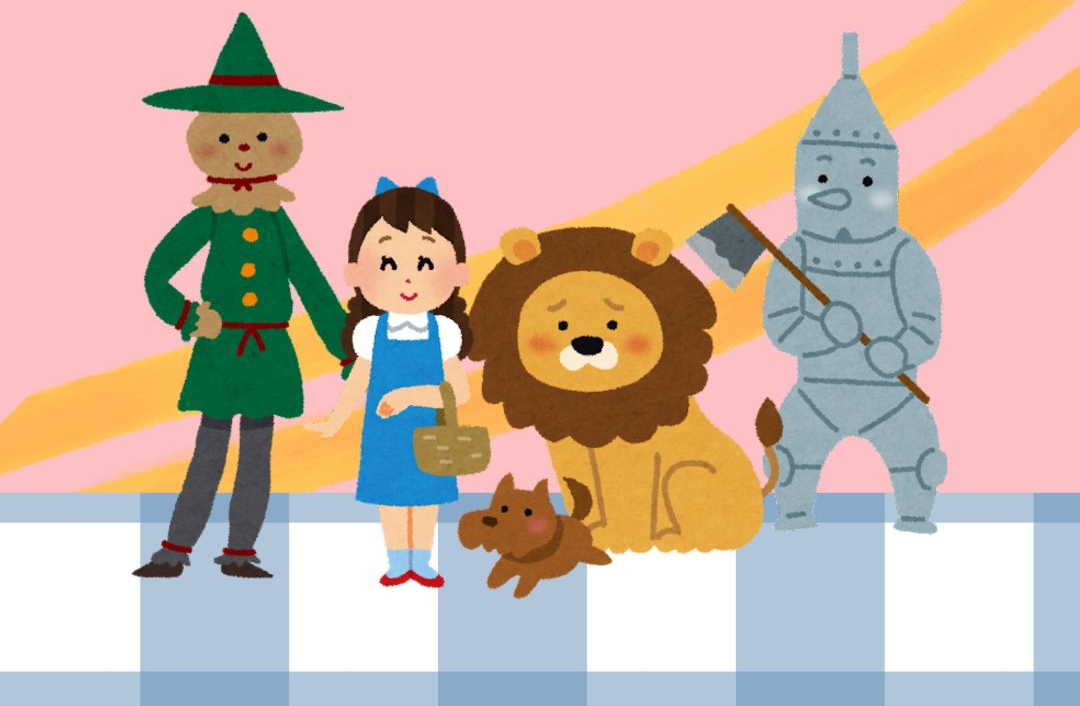
The Wizard of Oz is a simple story, one that I’ve always loved, but I was reminded of just how much I enjoyed it when I went to see the musical version in the Bord Gáis Energy Theatre. If you follow me on Instagram @katelovesliterature, then you will have already seen the photos on my grid.
As expected, it was a brilliant #theatretrip.
Two things captured my attention specifically during this adaptation. The first point is that I was very impressed by this production’s use of screens, and the second point is that I had forgotten how much I enjoy the simplicity of this story. Wicked is touring again currently, and I have my tickets for when it is on in Dublin, so even though I really enjoy Wicked, I loved seeing a villain relishing in being a villain. I’ll talk about this more shortly.
Stylistically, I loved this fresh take on a very classic story. The film alone dates back to 1939, and the winding quest to find one’s way home has been endlessly incorporated into various forms of media ever since. It is a popular trope. One gets lost and must find their way back, learning crucial life lessons along the way. It is a satisfying trope for a reason, and the theme of yearning for belonging somewhere is one that I believe everyone can relate to on some level.
I would call this production quite high-tech, and quite modern. The use of screens and taking a more neon approach to everything felt larger than life, which I think is quite appropriate for Oz. I was sceptical about the use of screens going in, as sometimes I find that screens end up taking over the entire production and no matter what, I think there is something to be said for solid sets and backgrounds that aren’t digital. I was pleasantly surprised though, as I felt there was a lot of care given to striking the balance of when to use screens and when to not, and I loved the bright, electric yellow-brick road that moved in pieces throughout the show.
In this production, in my opinion, a darker undertone was present. Oz was more imposing, darker, despite being lit up in neon. It was so bright that it was slightly unsettling, and for Dorothy, who is off on this imposing journey, it was fitting that Oz would seem gigantic and cold. Kansas felt darker too, with a layer of dust and grime persisting, and everyone was tense and on edge, even before the tornado warning. This worked well as it was easy to see why Dorothy felt so displaced, why maybe Kansas didn’t feel like home at first, and of course, Dorothy’s love for Toto was ever enduring. The style choices made sense, and the screens helped instead of hindered, so I would see this version of the production again anytime.
I want to take a moment to say congratulations, bravo, and well done to the cast and crew.
Aviva Tulley was simply charming as Dorothy. Her rendition of Somewhere Over the Rainbow received a well-deserved extended applause. She was the perfect Dorothy, charming and endearing, yet determined to persevere, not only to help herself, but to help her new friends too. I want to mention Benjamin Yates. He was the most wonderful Scarecrow. The Scarecrow is a vital part of the show. He is the first friend that Dorothy makes in Oz, and he is the first to join her, not leaving her alone on the journey. Their friendship is so sweet, and Benjamin Yates was a fantastic mix of sweet, funny, and earnest. The entire cast were fantastic though and, in my opinion, they all deserve a huge amount of praise.
Craig Revel Horwood was The Wicked Witch of the West. Craig was impressive and it was so much fun to see a villain simply revel in being a villain. I’ve decided that I will consider The Wicked Witch of the West and Elphaba to be two distinctly different characters. I know that many people probably view them this way already, but Wicked is presented often as the “untold side of the story,” of The Wicked Witch of the West. Wicked presents The Wicked Witch of the West as someone who was forced to become evil whereas in The Wizard of Oz, the witch is simply a wicked witch, and her vendetta against Dorothy is based on pettiness and anger alone. Yes, Dorothy technically dropped a house on her sister, but you always get the impression that The Wicked Witch of the West would have found an excuse to torment Dorothy anyway. Having The Wicked Witch of the West double up as the mean and spiteful Miss Gulch from Kansas is a testament to this. Miss Gulch is a spiteful woman who has an unfair vendetta against Dorothy. Miss Gulch takes pleasure in finding reasons to complain about her and act against her, going so far as even trying to take Toto away and harm him.
Craig Revel Horwood clearly enjoyed playing this iconic character, and I really enjoyed seeing a story with clear and plain stakes and triumphs again. The Wicked Witch of the West is an unapologetic antagonist, and the contrast between the surly wicked witch and the ever delightful, bubble-gum pink, moped riding Glinda was visually very striking and very fun to watch. They’re extreme opposites and the dynamic works very well onstage.
I’m all for nuance, especially in children’s literature. I believe I’ve made that very clear time and time again, but I do also feel somewhat frustrated when I see every villain getting the same “misunderstood actually,” treatment. Understanding why someone behaves as they do is important, and yes, sometimes evil is made, but I also do think there’s something to be said about acknowledging that some people simply have bad intentions. The Wicked Witch of the West in this production of The Wizard of Oz is evil just to be evil, and it was highly entertaining.
I’d see this show again tomorrow if I could.
Next up on Katelovesliterature.com, I’m going to be discussing 2.22: A Ghost Story.
Last month I was chatting to a friend and he brought it to my attention that there were apparently some discussions about “toning down,” or removing Tinker Bell’s presence from the Disney parks. An official Disney rep has since dismissed this news, claiming it is entirely false and while Tinker Bell does not appear in character meet and greets in Florida, she still features heavily in parades and firework shows and does appear at meet and greets in other parks.
Now despite an official rep saying the statements about Tink being removed due to her being a “problematic character,” are false, the topic really inspired me to write about Tink. The idea that she is a “bad role model for girls,” is the point that specifically bothered me. Tink was allegedly labelled this way because of her being “body conscious,” and “constantly seeking the attention of Peter Pan.”
I feel these labels are unfair, and I feel that I am constantly noticing a rising trend of audiences making comments about characters and texts, seemingly, without fully understanding them. There is so much nuance in children’s literature and lately I find that is being completely missed.
Tink is a character who has been part of the children’s literary canon since she first appeared in the original version of Peter Pan. J.M Barrie’s staged play was published in 1904 and since then Tink has made her way into the hearts of many. She is feisty, she is cheeky, she is stubborn, she is determined, she has her flaws of course, but who doesn’t? I am also aware that Peter Pan is a problematic text in other ways. J.M Barrie’s highly stereotypical and ignorant portrayal of Native Americans is an aspect of the text that newer adaptations seek to counteract. I also think that in 2024, Wendy’s character arc needs to be presented carefully because she is a Victorian character who was created in the 1900’s, meaning that her aspirations have been moulded to fit the societal norms and values of that time. Wendy dreams of being a mother, and while there’s nothing wrong with wanting to be a mother in 2024, I feel it is important to present motherhood as a personal choice rather than presenting it as obvious that Wendy would want to be a mother simply because she is a girl. Wendy is a storyteller, Wendy is nurturing, Wendy is romantic, and I want her to be all of these wonderful things because that is who she is, not because she’s a girl so she must be. It is a nuanced line and many adaptations struggle with it. So we’re dealing with a text that has some undeniable flaws, why am I defending Tink specifically?
I want to take a look at the alleged reasons behind why she is problematic.
It doesn’t matter to me that this seems to be fake news, there are some points raised that I want to explore.
Tink is Body Conscious, and She is An Example of Unrealistic Body Standards.
In my opinion, this is an easy one, because I know what is being referred to here. Instantly I think of the 1953 Walt Disney animated version of Peter Pan. Margaret Kerry, actor, dancer, singer, and all-around artist served as the character model for the 1953 animated version of Tink. In true 1950’s fashion, Kerry had a figure that was considered the ideal of the time. Small waist, generous cleavage, and curvy hips. If you look up some of the behind-the-scenes images of Kerry posing as Tink, you’ll see she is wearing an outfit that would not be out of place in the wardrobe of Marilyn Monroe.
Immediately, without even having to rewatch the animation, a scene came to mind. There are scenes where Tink is appreciating or expressing frustration about her figure. When she can’t fit through certain spaces, she angrily looks at her behind, and there’s another moment where she is quite proud of her hips in the mirror. I feel it is important to remember here that this cartoon was released in the 1950’s (and in production earlier,) and she was created by a team of men. They are even called “Disney’s Nine Old Men.”
There are a few points to make here. Body standards and beauty standards and societal norms are always changing, so while we can acknowledge that a lot of things would not be written the same way today, remembering the time, place, and context of when certain things were created is important. The moment something is written down or captured on film, it is out of date, and who knows what will be out of date in fifteen years that are considered fine today? That is always going to be an ongoing issue to consider when it comes to consuming media. So of course, the beauty standards of the 1950’s are out of date and highly informed by the patriarchy, but I fear that is a point that we will always have to contend with in some way. This is why I feel it is unfair to critique Tink for her body consciousness, when actually, it was a team of men in the 1950’s who animated her that way. The scene of her expressing frustration with her behind was animated by a group of men who likely found that highly amusing, and I just don’t think it is fair to place the blame for that on Tink. The other issue I have with it is that I don’t think Tink admiring her own curves is necessarily a bad thing. If the message we want to send is that we should always be comfortable in our own skin and that all shapes and sizes should be celebrated, Tink being happy with how she looks and outwardly expressing that should be a good thing.
This point leads me to another alleged issue – Note that I keep saying alleged as I’m aware these articles about Tink have been declared click-bait.
Tink Constantly Wants Attention from Peter Pan.
Tink has been accused of relying on male validation because she constantly wants the attention of Peter Pan. There have also been notes about Tink’s jealousy towards Wendy, and the fact that Tink does not always have Wendy’s best interests at heart. These points grate on me for a few reasons. The first being that I feel these points are overly simplistic and they ignore the source material.
In 1911 as part of a fundraiser for Great Ormond Street Children’s Hospital, Peter Pan was published in the form of an illustrated book. It is often credited as the first version as well as being the most beautiful one. In this version, readers can find the following quote about Tink …
“Tink was not all bad: or, rather, she was all bad just now, but, on the other hand, sometimes she was all good. Fairies have to be one thing or the other, because being so small they unfortunately have room for one feeling only at a time.”
Tink has been criticised for being a highly emotional character, one who expresses anger, jealousy, and frustration. There have been comments made alluding to the idea that these traits are not something that should be modelled to children. I take issue with this. Children are people. Children grow up and become adults, and they have a full range of emotions. We all feel anger. We all feel jealousy. We all feel frustration. Why? Because we are human. We don’t feel only good things 24/7 and that does not make us bad people. Children deserve to know that it is okay to have big, negative feelings. They’re allowed to get angry, they’re allowed to get jealous, they’re allowed to get frustrated, most of all, they deserve to know that they are allowed to express a negative emotion and that does not make them a bad person or a “bad role model.”
I actually feel that if Tink was to be “toned down,” because she dares to express her emotions that this would have a negative impact. Removing representation of negative feelings in works of fiction will not stop people, especially children, from having negative feelings in their real lives. Removing that representation will simply make people feel alone. I feel it is more important to showcase characters having those negative feelings and working through them. If characters act less than kindly because of those negative feelings, then I think it is important that we illustrate how sometimes actions may hurt others, but we can make amends. This is what Tink does.
Returning to the quote I’ve referenced above, it is crucial to note that Tink is not a person, but a fairy. She is a mythical, magical being, and because fairies are so tiny, she can only feel one emotion at a time. This means when she is angry, she is ONLY angry, and when she is jealous, she is ONLY jealous. That is why some of her actions are very extreme, it is because she is totally and utterly consumed by one feeling at a time. Another point I want to make is that when people accuse Tink of acting in extreme ways, I think they forget that Tink exists in Neverland which is a magical place based on extremities. I also feel that if we’re going to critique Tink then we need to also critique Peter Pan.
Peter Pan is an extremely interesting character. He is often hailed as the personification of childhood itself. He represents freedom, whimsy, imagination, and the carelessness of youth. He is also a cautionary tale. There are also darker, more tragic takes on the boy who would not grow up. Wendy represents all you gain when you grow up, and she poignantly shows what you lose too. When Wendy grows up, she is never able to return to Neverland, she is never able to fly again. This represents a child growing up from innocence to maturity. When children mature and learn things they did not know before, they can never go back to the carefree innocence of not knowing, of not understanding. Those of us who refuse to grow up, who refuse to mature, they miss out on all that adulthood gives us because immaturity means you cannot engage properly with those who have evolved. There are so many ways to explore the tale. Some imagine that Peter Pan represents children who died young, so he literally cannot grow up because he represents those who did not make it to adulthood. Neverland is sometimes viewed as a place where children go when they die and Peter Pan is a figure who helps them on their way. In other variations, he is a darker figure, a kind of authoritarian ruler of Neverland. In early drafts of the Disney adaptation, Peter Pan actually kidnaps Wendy because of how much he enjoys her stories, but ultimately Disney decided a kidnapping plot would be too dark.
If we’re saying that Tink acts very emotionally, then we must acknowledge that Peter Pan does too. He is hot headed, temperamental, and he is only happy to play if people play by his rules and his rules only. This authoritarian style is illustrated in the type of father he pretends to be when he, Wendy, and the Lost Boys are playing house. While Wendy is nurturing, warm, and full of stories and lullabies, Peter Pan is cold, distant, and rules with an iron fist. There are even times when the Lost Boys cannot eat because Peter Pan will not imagine food for them, and he is quite harsh in his demands of what the Lost Boys can and can not do.
They cannot speak of mothers, they cannot know more than him, and very early on in the story when Tootles shoots Wendy out of the sky, Peter Pan is prepared to stab him. Tootles shot Wendy with an arrow because in Tink’s jealousy she told him that Wendy was a “Wendy-Bird.”
While I am not suggesting in any way that what Tink did here was nice, it does bother me that audiences will label her a “bad role model,” because she hurt Wendy, but then they will run right by how Peter Pan was prepared to kill in anger to get revenge. All of these actions are part of the make believe of Neverland and it is also crucial to note that in these critiques of Tink, her heroism is being greatly overlooked. As the story goes on, she warms up to Wendy and in the end, she selflessly drinks the poison intended for Peter Pan to save his life. The point I’m making in this discussion is that if we’re going to discuss Tink, then mention it all!
There are two more reasons why the “Tink is too emotional,” critiques bother me.
The first is that I feel female characters should be able to express all emotions without being labelled in any manner, and the second is that Tink is expressing some very valid frustrations over Peter Pan’s treatment of her albeit she is doing it in an extreme way – again because she can only feel one thing at a time.
So let’s keep exploring …
The point I’m making here is very straightforward in my opinion. I really don’t like it when female characters are given labels because they are more than just happy. Peter Pan is many things throughout the story. He is happy, adventurous, jealous, angry, prideful, cocky, and then in the end, when Wendy is all grown up, he is devastated. Do we label him? No. His character is interpreted in many different ways, and he’s discussed in detail when those differing interpretations are explored, but he isn’t labelled in the way that Tink was allegedly labelled. His layers get appreciated, whereas all of Tink’s nuance gets ignored. This is annoying.
Female characters should be able to be as emotionally complicated as male characters, and appreciated for the many ways they can be interpreted instead of just being smacked with a one-dimensional label.
The other point that grates on me in regards to this idea is that up until Peter Pan meets Wendy, Tink was his best friend. They did everything together and then when Peter Pan meets Wendy and becomes enamoured by her and her stories, like a child with a new toy, he quite coldly discards Tink. He ignores her, he does not consider her feelings, but he is all too happy to use her pixie dust so everyone else can fly. I think Tink is absolutely right to express that she is upset and angry about being discarded. She expresses her frustrations in a fantastical, extreme way, yes, but that is because Neverland is a fantastical, extreme place. Crocodiles bite off hands, pirates chase children, mermaids swim in lagoons, and flying is possible. Tink’s fantastical expressions fit, they are part of what makes Neverland Neverland. At its core though, the point I’m making here is that I do not like the implication that Tink expressing valid frustrations over being cast aside makes her a ‘bad role model,’ nor does her wanting some respect and appreciation from Peter Pan mean that she is ‘constantly seeking his male validation.’
If we say that Tink is alway seeking male validation because she does not appreciate being tossed aside, then what we’re teaching children, what we’re teaching young girls specifically, is that if they stand up for themselves over being mistreated or ignored and if they say that this is unacceptable, then they are going to be labelled and that is not a lesson that I’m okay with teaching any child, especially not young girls. If you do a lot for someone, if you’re a loyal friend, if you’re always there to help, if you give parts of yourself – in Tink’s case, her pixie dust – then you are absolutely in the right to express anger and upset if you’re tossed aside in favour of someone else. Peter Pan is completely dismissive of Tink’s feelings and I think if she gets labelled as a ‘bad role model,’ because she does not let him dismiss her without standing up for herself then I think we’re heading down a slippery slope.
Tink’s Adventures Continue …
In all of my above points, I’ve been speaking about the version of Tink in the 1904 version of Peter Pan and in the Walt Disney animated film version. I have not even touched on the fact that Disney created an independent set of films, the first was released in 2008, centred around the character Tinker Bell.
Tinker Bell is a tinker fairy, which means her talent is fixing things, tinkering with things, she is an innovative, creative, inventor and her fiery, determined spirit is what fuels her to keep going despite any obstacles that block her path.
In these movies, Tink worries that she is useless because she can’t figure out her talent, and then she worries that being a tinker fairy is not exciting enough. She struggles to find her place, but she does not give up. She perseveres, she makes friends, and she learns that her skills are important. She learns how to best use her talents for good. The themes of these movies, particularly the first one, is that everyone has different skills and all those skills are important. We all can’t do the same thing and instead of doubting ourselves, we can find what makes us stand out and be proud of that talent. They’re full of feel good messages and in my opinion, they are great movies for young children to enjoy because they teach that even if you can’t do one thing, there will be something else that is for you to do and you will thrive. They teach young viewers to never give up. The ironic part of all of this is that when you go to meet Tink in the Disney parks, you’re meeting her and the other fairies in Pixie Hollow, which is from the Tinker Bell fairy movie franchise and not the original Peter Pan canon. So the version of Tink that was being judged (the 1904 version,) is not even the version that is supposedly being presented to audiences by Disney. We’re meeting the Tink who has starred in her own stories, and I think it is completely unfair to ignore all of the individual character development that Disney created for Tink.
To wrap up…
I think it is unfair to only critique one side of Tink while ignoring her heroism and determination.
I think it is a terrible idea to suggest that children should never see negative emotions in fiction and the idea that experiencing and expressing a negative emotion makes one a ‘bad role model,’ is one that I think is the truly problematic idea.
I don’t like the fact that these labels reduced Tink’s very valid anger at Peter Pan down to being her supposedly ‘constantly seeking male validation.’ I think there needs to be more care given to how we discuss these kinds of characters, because if we’re going to say that Tink should never have expressed any sort of bad feeling or upset over how Peter Pan treated her, then I think we need to stop and question what sort of message that would teach young readers and viewers.
If anything, we should want to teach them to speak up when they feel someone is being mean or treating them unfairly. We don’t want them to allow themselves to be dismissed.
I’m aware that this discussion was fuelled by what ended up being click-bait, however I don’t care. I felt the points raised were worth exploring and there were points that I wanted to make even after learning that the initial article was, thankfully, false. I strongly believe that we need to remember that nuance has to exist in children’s literature, and I really feel that material needs to be understood before labels are thrown around. Children are highly intelligent and I don’t want their literature to be talking down to them, which I worry will become the case if we continue to label stories and characters in this way. There needs to be good and bad, light and shade, stakes and triumphs. There needs to be characters like Tink!
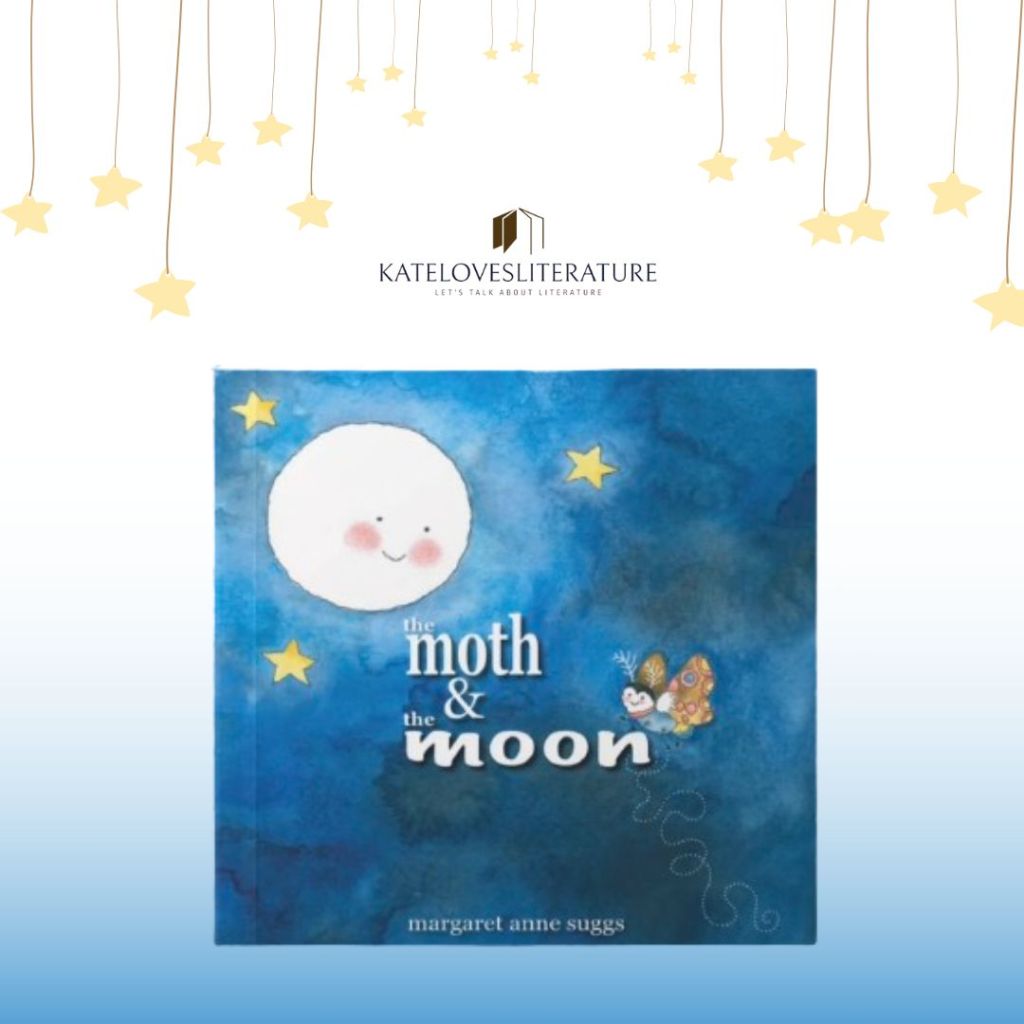
This week I am celebrating the official launch of The Moth and the Moon by Margaret Anne Suggs.
*Please note, this is not an ad. This is not sponsored or paid for in any way, but I do want to take a moment to cheer on my former colleagues as they’re amazing!*
If you’ve been following me for a while then you’ll know that I have recently started a new job. I had the pleasure of working with the Beehive Books team since 2022, and I am thrilled to be invited to the official launch of The Moth and the Moon by Margaret Anne Suggs.
This new book is a charming story about Rosie the moonstruck moth as she sets off through the night sky in search of the moon. The story is so sweet, and the illustrations are simply gorgeous. Anyone who loves a sky scene will love these starry illustrations. As a night owl, I love this book.
When I was little I would have loved a story that was all about an adventure through the night sky, exploring the stars and everything that sparkles. There’s something magical about being up late when it feels like everyone is asleep but you. If it is not obvious, I’m still a night owl to this day. Just like Rosie, I’m most definitely moonstruck!
I will be #OutOfOffice next week as I am heading off on an adventure of my own. I won’t be publishing a discussion next week, but I will be active on Instagram so come and join the fun!
Sunny season is approaching. I am very excited about the months ahead.
I hope to do some more exploring this summer. I’ve been very fortunate because I have had the opportunity to travel a lot, and one thing I am excellent at is making sure that I’ve got something to keep me entertained while I’m on a flight.
If I’m being perfectly honest, I try to sleep for as much of the flight as I can, but sometimes that isn’t possible, so I do always ensure that I have some movies or shows picked out.
I don’t read on flights very often because I am prone to getting motion sickness, and I find that it doesn’t impact me as much if I’m watching something. I prefer to read when I’m tucked up in bed anyways. With all of this being said, I’m putting together a list of my plane picks. My absolute go to watch-list for when I’m in the air, and you might feel inspired for the next time you’re catching a flight!
The Golden Girls
It goes without saying that I watch The Golden Girls when flying. I watch this show all the time. It is my comfort watch, my go to, it is easy and fun. I use Disney +, so I usually download an entire season of this show before a flight so I can watch without Wi-Fi.
The episodes are 20 minutes long so watching 3 is a great way to pass an hour.
When I was flying to NYC back in January, the flight was 6 hours long. It was an early flight so I slept for the first 4 hours and then had 2 left. I watched 3 episodes of The Golden Girls, and then as we enter the last hour, we begin to descend anyways so that was a relatively long flight that went by in no time at all.
Speaking of Disney +, I usually have one or two classic Disney movies downloaded too so I can watch without Wi-Fi if the mood strikes me. I also download a few episodes of something like Modern Family, or something similar, so I have options of shows that are fun, easy, and not too long.
The Real Housewives of Beverly Hills (Insert your personal reality tv pick here).
When I want to pass the time, when I don’t want to think, when I want to indulge in a guilty pleasure, this is when I turn to reality tv. The Real Housewives of Beverly Hills is my reality show of choice. It is ridiculous. It is lavish. It is an easy way to pass the time. An episode is an hour long, so 2 episodes is 2 hours passed without even noticing.
Father of the Bride
When it comes to movies, I like to turn to old favourites when I’m on a flight.
I usually don’t watch a movie that I haven’t seen before when flying because planes can be loud and I’m obviously using a smaller screen, and in my case, sometimes I feel sick if motion sickness hits, so that is why I like to watch movies I know and love. I like turning something on that I know I enjoy watching. I know it makes me laugh. I find that watching old favourites that are familiar helps when I’m not feeling 100% amazing, and something like Father of the Bride is a lovely way to spend an hour and a half.
Other movies that fall into my plane picks for these same reasons are Miss Congeniality,My Fair Lady, When Harry Met Sally, Roman Holiday, Ruthless People, and Dirty Dancing.
Here there is a pattern and you can see the idea. I like to watch short, easy to watch shows that pass the time, and if I am watching a movie, I like to turn to old favourites. I find doing this has always helped me enjoy flying more, and I think having a list of favourites saved and downloaded makes getting ready to travel so much easier.
Follow me on Instagram if you don’t already for updates on what is #ComingUpNext!
I have always been a reader. I’m sure that is very obvious by now.
Over the years I have built up a collection of books that I am proud of, and I’ve had some of the books since I was very young.
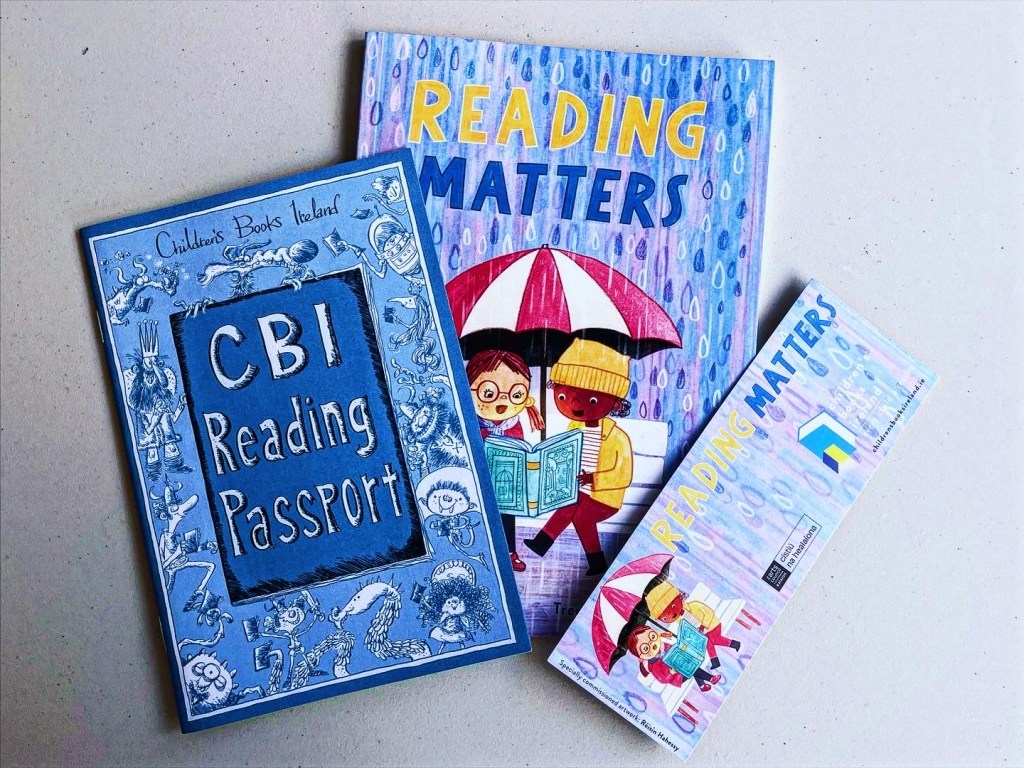
If you’ve been a reader of my blogs for a while, you already know that I am a Children’s Books Ireland book doctor. I absolutely love it when I have the chance to participate in the CBI Book Clinics. Chatting to young readers about the books they’re enjoying is always so much fun, and I always leave the event feeling inspired in some way.
If you follow me on Instagram @katelovesliterature, then you’ll already know that last Saturday I was in Galway. I got to join Patricia Forde’s #WholeWideWorldBusTour and it was a gorgeous sunny, book-chat filled day. I had the pleasure of chatting to kids from the ages of three to ten, and I came away from this book clinic with a new appreciation for picture books.
There’s been some exciting events happening in my life lately. I celebrated my Master’s graduation and I thoroughly enjoyed my ceremony. I have also set off on a new work adventure. After nearly two years of working with the wonderful Beehive Books team, I’ve started a new role. I mention this because the last two Beehive books that I had the pleasure of being part of were both picture books. Skipping Stones by Tatyana Feeney and The Moth and the Moon by Margaret Anne Suggs are both out now and while this piece is not an ad, or paid for in any way, I will say that I’m delighted to see these books on the shelves.
It is safe to say that lately ideas about picture books have been running through my mind.
I’ve been thinking about how much I enjoy them to this day, and I’ve also been thinking about how important they are when it comes to our reading journeys.
Unfortunately picture books don’t always get the credit they deserve. Sometimes picture books are referred to as “Not real books.” This couldn’t be further from the truth. Picture books are hugely important and in this piece I’m going to highlight that.
My favourite thing about picture books, and one of the most important things to note about picture books, is the way they help young readers develop their visual literacy skills.
When we are little and just beginning to look at books, before we even start to learn how to read words properly, we engage with picture books. I would argue that visual literacy is developed before we can understand the words on the page. You can understand what is happening in a story by looking at the pictures alone. In time, the pictures and the words work together to create meaning, but for readers who may be struggling with the words aspect, they can glean a high level of understanding from just the pictures. Picture books transcend language barriers. The saying “A picture is worth a thousand words”, comes to mind. This is true. We pick up so many visual cues from images and so many factors come together to create meaning.
When we look at a picture, we look at colours used, facial expressions, placement on the pages, and the scale of the drawings etc. An easy example that I use to explain this further is a playground scene. Imagine a picture of a playground. On one page, everything is bright, there are lots of children playing. Some on swings, some on the slides, they’re depicted smiling and laughing, the colours are bright and rich. Think yellows and oranges and greens. Now on the other side of the page – the other side of the playground if you will – imagine there is a drawing of a child by themselves. They’re smaller. They’re alone on the page. They’re not smiling. Maybe they’re crying, and the colours are muted. Think blues and greys. Let’s think about what all these factors portray when they come together. A picture has been painted of a child who is lonely at the playground. Everyone else is bright and having fun, but the lone child is sad, perhaps telling us readers that they struggle making friends or maybe they’ve been left out. We can decide what we think for ourselves, and by doing so we’re enhancing our interpretational skills and our emotional comprehension skills.
Looking at pictures and deciphering what they mean by using visual cues is a life skill and it is one that we should hopefully continue to develop as we grow up. For example when we watch a movie, we should be able to pick up on meanings based on what we see. In our personal lives, we may be able to tell how someone is feeling by the look on their face alone. When young readers engage with picture books, they are practising all of these key skills in a really fun way as picture books invite readers into bright, colourful worlds. Looking at beautiful pictures is a great way to encourage a reluctant reader, or it may entice someone who is a visual learner, and regardless, pictures make learning much more fun!
One of my closest friends is a speech and language therapist and when I told her that I was working on this piece, she told me to feel free to also share that speech and language therapists strongly advocate using picture books because they provide ways to model language by giving visual supports that help children understand what is being spoken about. I was delighted to learn this as I’ve always felt that picture books are an incredible tool in many ways, but even beyond a speech therapy setting, having a visual aid to help us understand what is going on is always appreciated in my opinion.
Picture books, especially wordless picture books, also give young readers a chance to build their confidence and use their imaginations. When you can decide for yourself what is happening based on what you see, you’re letting your creativity soar as well as building up confidence when expressing your thoughts and opinions.
So if you have some picture books at home from when you were young, don’t throw them out. If you have young readers at home who love picture books, don’t dismiss them. Dive in instead. You may just learn something new.
For all updates about what is #ComingUpNext make sure you’re following me on Instagram @katelovesliterature
If you thought I was finished mentioning New York, I’m afraid you were wrong!
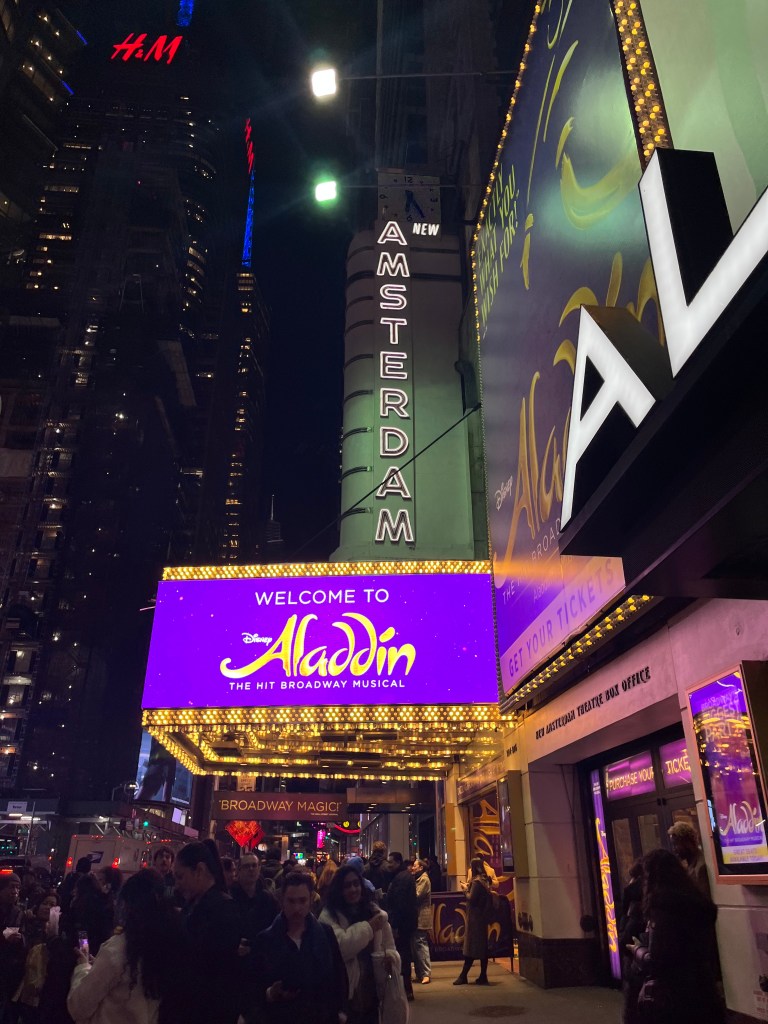
Back in January I was whisked away to the big apple on a surprise trip. It was a dream, and while we were there my Mam and I went to see the magical Aladdin on Broadway.
I knew that the UK tour of Aladdin would be making its way to Dublin in April, so I already had my Dublin tickets when my Mam surprised me with this trip. My excitement only doubled as I love having the chance to see a production twice, especially in different places as small changes can be made. If you’re a theatre lover like me then seeing these little changes will fascinate you.
Let me start with the obvious. Aladdin onstage is a beautiful show. The costumes are bright, vivid, and they sparkle beautifully. The stage comes alive with colour and movement from curtain up to curtain down. It is a magical spectacle. The story of Aladdin is one we know and love, and the classic songs from the Disney movie are complemented by the songs that were composed for the stage production. If you’re a fan of the movie then you will love the show. It really is as simple as that.
Similar to the movie, the stage show is filled with pop-culture references as those references are part of what makes the role of the genie so iconic. This is where seeing the show in two different places becomes really interesting because in New York, some of the crowd work was catered to NYC landmarks, whereas those references were amended to make sense to an Irish audience in Dublin. These little details fascinate me as I love seeing all the ways a show can change and move.
The story of Aladdin is one that I believe will always have a timeless quality to it.
Aladdin is a poor, kind, young man who has no family and he has to resort to stealing and getting into mischief to survive, but beneath his bravado and schemes, there is a heart of gold.
He is earnest, he is charming, and he will always try to do the right thing. Aladdin and Princess Jasmine connect because they both feel trapped. Aladdin cannot do anything because he has no money, and people look down on his efforts to survive. Jasmine, while she acknowledges that she lives a privileged life, she too feels trapped because of the royal protocols that she must follow. The stage show takes the time to specifically illustrate her fears about being forcibly married off to a stranger. I appreciate this aspect of the stage show, because I think in stories where love interests come from two very different classes, it can sometimes be hard to relate to the person who has the wealth and the privilege, because while of course everyone can have struggles no matter their class, it is undeniably easier to deal with those problems when you have money, shelter, power and influence.
While Jasmine does not have the same financial struggles as Aladdin, the fear of being married off to a stranger and living a life in which your voice is never listened to is a real fear, and her desire to run away and live her life on her own terms is easy to root for because of how well the stage show illustrates her arc.
Jasmine and Aladdin also match because they both mirror each other’s desire to be fully seen. Aladdin wants to be seen for who he is as a person instead of being seen as nothing more than a poor man. He is viewed as a street rat and his worth as a person is dismissed entirely because of his station, whereas in Jamine’s case, her station is all that people see. They see her wealth, they see her title, they see the power they will have through associating with her and her father and they don’t care about who she is as a person or how she truly feels or what she has to say. So they both feel alone and when they meet, for both of them it is the first time that anyone truly listens to how they feel and understands it. Their plan to run away together is sweet and very earnest and their common ground makes them a very likeable couple.
It is a story filled with magic and love. When Jafar, the sultan’s crooked advisor, learns that Aladdin is the diamond in the rough that he needs to help him procure a magic lamp, he tricks Aladdin into retrieving it for him, manipulating Aladdin’s wishes to make his late mother proud of him. Of course Aladdin ends up rubbing the lamp instead so now he has a new friend in the genie who is going to change his life with three wishes.
While I adore Aladdin and Jasmine, the genie is the best character in the show. He is funny, he is full of energy. Huge props to all actors who have played this role because it is non-stop. The genie plays so many key roles in the show. He narrates, he does crowd work, he delivers larger than life performances, and he is the mentor character to Aladdin. He is significant to Aladdin’s emotional arc throughout the show, and it is the genie who helps Aladdin discover his self-worth and helps him understand that wish or no wish, he was a Prince all along because of his kind heart. Jasmine loved Aladdin before he made his first wish, and the genie helps him see that.
His role as Aladdin’s mentor is doubly touching because Aladdin is an orphan who misses his family, so the genie gives him the loving, parental guidance that he is missing.
From beginning to end, this show will have audiences completely in awe.
I am so thrilled that I had the chance to see this show twice. I would go again in a heartbeat.
It is dazzling, funny, and filled with magic. Perfect for date night or if you have a Disney lover at home. If you get the opportunity to see Aladdin don’t miss out.
Make sure to follow me on Instagram @katelovesliterature to stay up to date with what is #ComingUpNext
Derek Landy fans will be delighted to dive back into the world of Skulduggery Pleasant.
*Thank you to HarperCollins Ireland for sending me an early copy of this book.
Please note that while I received this book in #bookmail, my review is entirely my own.
This is not a paid review, nor is this review an ad or sponsored in any way.*
I always enjoy stepping into the world of Skulduggery Pleasant. Personally I’m a fan of crime thrillers and mysteries, so I was happy to see that Landy has returned to his investigative roots in this book. A Mind Full of Murder by Derek Landy is the latest installment in the world of Skulduggery Pleasant. This new book sets us up for a new trilogy and I must say that this book left me looking forward to what is coming next.
This book follows Skulduggery Pleasant and Valkyrie Cain as they try to stop a mysterious killer from murdering more innocent people. In order to stop this villain, they must solve riddles that the killer has left for them. Fast-paced and mystery focused, this book will have you gripped with each turn of the page. Concise, and featuring less characters than his previous works, Landy has created a story that flows really nicely. I also enjoyed the fact that Skulduggery and Valkyrie are working closely together again.
The tone of this book feels more mature than previous installments of this series. Landy’s passion for horror shines through in this book, successfully resetting the tone of this series. This book, while still showcasing Landy’s sharp wit, feels more serious than before. Some of the action described (injuries, deaths, etc.), definitely reads as though Landy is aiming for an older audience this time. Many readers have been a fan of Skulduggery Pleasant for years so I would argue that there is a certain element of nostalgia to be found in this book, and it is clear to see that Landy enjoys using certain tropes (mystery reveals, discovering parentage etc.)
I would argue that certain kinds of reveals can start to feel somewhat repetitive at times, however that doesn’t take away from the overall enjoyment of this book.
I think some characters will be missed, however I think the return to the classic Skulduggery/Valkyrie dynamic will please many readers, and we will see who returns to the pages as this new trilogy unfolds.
I’d recommend this book for readers 12+
Perfect for readers who enjoy crime mysteries as well as ideal for anyone who wants to become more familiar with horror.
Follow me on Instagram @katelovesliterature if you don’t already so that you are up to date with what is #ComingUpNext


 Katelovesliterature.com