Featured

Derek Landy’s “A Heart Full of Hatred”: Mature Themes in Skulduggery Pleasant

A Heart Full of Hatred by Derek Landy. 

A review by Kate O’Brien. 

Landy has brought us back to the world of Skulduggery Pleasant yet again. In this latest book,  Valkyrie Cain learns that she is the next target of a killer. Skulduggery and Valkyrie find themselves wrapped up in another murder investigation, but the most unsettling part is that this case feels all too much like a case they just closed. 

For the first time, Valkyrie reflects on the dangers of what she does as the last case nearly took the lives of both her sister and her girlfriend, and now the same pattern seems to be emerging. Are those whom she loves in danger again? The killer is working hard as more bodies are piling up and the clock is ticking. The elites of the sorcerer world are planning to gather on a remote island to witness a special ceremony that might change the society forevermore. As expected, nobody is safe. If you’re a fan of Landy, you know that you’re in for a book of twists and turns. 

The Skulduggery Pleasant series continues to evolve, and those who know Landy’s style to be action-packed and very funny due to his sarcastic wit and sharp, fast, and very dry humour, will be glad to see that A Heart Full of Hatred remains true to that known and loved writing style. 

I will say that I feel as though this book is more character focused than some of the previous books. It does feel more mature in tone, especially as Valkyrie is beginning to reflect more on her feelings, and notably, on her fears. I’ve often said that I think that readers who grew up loving the Skulduggery Pleasant series will definitely enjoy these books, perhaps a bit more than readers who are just discovering the series now. That’s not to say that new readers would not or could not enjoy the series now, but there is a special sense of nostalgia that accompanies a series when you started reading it as a child and you continue reading into adulthood. How we feel about the characters, and how we relate to them evolves as we age, and I think the fact that this series has been in the world for so long is part of why some of the arcs are so impressive. 

I do think that I would be recommending the books now to older teens because they do feel darker now, especially because of how the tone has begun to shift. There is always a political and social awareness that can be identified in Landy’s writing, and in terms of viewing things through a lens of childhood and YA reading, there is absolutely a notable shift in Valkyrie specifically, because this person who was once quite cocky and believed they were indestructible now understands that they very well could be killed, but Valkyrie looks danger in the face anyways. She will not be deterred from investigating these murders. In this shift though, I would argue that readers can relate to this arc because as we get older, we do become more aware of our own limits and how things can threaten us, and we don’t have the same fearless abandon that we had as children when we didn’t understand that there are threats that are very real. So, I do think that this idea of feeling fear but going forward anyways really appeals to long-term fans of this series, because although the world of Skulduggery Pleasant is filled with magic, mystery, and wonder, the personal arcs we get to see are still very relatable outside of the fiction. 

I think it is quite obvious that Landy is leaning into horror genres that he loves when writing these newer books. Based on Landy’s dedication alone, in which he dedicates A Heart Full of Hatred to Freddy, to Michael, to Ghostface, “to all of the slasher movie killers…to all of the wonderful ways they’ve thought of to kill somebody …also to those who survived their rampages, who stopped running, turned around and kicked their asses,” I do think it is fair to say that this book feels very much like a nod to all the slasher movies that Landy himself must love. The book could almost be a great way to introduce a teenage reader to the slasher genre, but beyond all of this, I do think that resilience is the key theme of this latest book. 

There will always be things to fear, dangers will lurk more often than not, and sometimes we will fear for the ones we love most, but we cannot hide from those dangers. We must face them head on and always find the light in the dark. 

I would recommend A Heart Full of Hatred to any long-term Landy fan and to readers 14+ 

Thank you to HarperCollins Ireland for sending me an advanced copy. Please note this is not a paid review, not an ad, not PR etc. I was not asked to write anything, but I wanted to share my thoughts and as always, all thoughts and opinions are my own. 

Stay tuned for more literary discussions coming soon on Katelovesliterature.com 

Follow me on Instagram @katelovesliterature if you don’t already. 

A Night with Jane Casey: Exploring The Secret Room

I had the most lovely, literary evening on Tuesday night in the Clarence Hotel, courtesy of HarperCollins Ireland. It was a pleasure to be invited to the “proof party” to celebrate Jane Casey’s upcoming new book. The Secret Room is a locked-room mystery, so fans of Agatha Christie are in for a treat. It is always amazing to be in a room full of very enthusiastic book lovers, and it was so lovely to meet Jane in person.

Coming out in April this year, The Secret Room follows the very privileged Ilaria Cavendish as she checks into a luxury hotel in London. The glamour promptly fades when she is found dead in the bath by her lover.

It must have been an accident. After all, no one went into the room with her and no one came out, and yet, all the signs point to murder.

DS Maeve Kerrigan enters the scene, happy to have a case like this to take her mind off of everything going on at home. When her partner, DI Josh Derwent, is arrested, Maeve must investigate the two cases side by side, not wanting to face what will come to be if she fails.

Jane said she hopes this book will be a “just one more chapter” page turner, and based on the fact that she has described it as a story that will appeal to classic Agatha Christie fans, I’m excited about diving in.

I’m a fan of crime fiction, and I can thank my mother for that. She has always been a fan of Michael Connelly and too many other authors to name. Our windowsills at home are filled with books all about mysteries and cold cases, impossible cases that just don’t make sense until they do. We also watch our fair share of detective series together. Some are better than others, some are quite formulaic, I can admit that, but we still always have a great time watching a story unfold.

As you might imagine when I came home with this proof, she immediately said she wants to read it after me, and I already know that the concept of Jane’s locked-room murder is going to have her racing through the pages.

So, what is a locked-room murder?

Popular in crime fiction, a locked-room murder is a type of crime that seems impossible to commit. It usually involves a crime scene that, appears to have only been entered by the victim. In this case, Ilaria checked into her hotel room and locked the door. She went into her room alone. Nobody else went in or out, and then she was found dead. How did that happen?

Another example is if someone enters a room that has been sealed from the inside, meaning that nobody could get in or out, and there does not appear to be another way in at all e.g. there are now windows, no backdoors, but when the body is found, it is clear that a weapon was used, but in the sealed room there is no weapon to be found. So, where is that weapon now, and how did the perpetrator get in and out after using it?

The locked-room mystery presents readers with an impossible case, one that couldn’t have happened and yet it did. That is what is so addicting when our detectives enter the scene because they have been presented with a very strange puzzle, and we go along with them as they unravel what went on. Nothing is as it seems when faced with a locked-door murder. Readers can expect lots of twists and turns, dead ends and strange nuggets that become leads, and before you know it, you’re hooked and desperate to know more.

I look forward to writing a full book review after reading The Secret Room by Jane Casey. As always, all thoughts and opinions shared will be completely honest and completely my own.

In the meantime, I would like to say thank you again to the HarperCollins Ireland team for inviting me on Tuesday evening.

If you follow me on Instagram then you will already know that I have two literary discussions coming up soon.

Having just seen Blue Velvet, I plan to discuss the intoxication of morbid curiosity, and I am looking forward to seeing King Lear in the Gate very soon, and I plan to write about the obsessive nature of integrity.

Stay tuned.

Featured

Must-Read Books of 2024: A Journey Through Darkness

As an avid book lover, it is always hard to pick any absolute favourite reads, and I did read a lot of books that I loved in 2024. In spite of this, I have decided to compile a list of what books were my favourite reads. They’re in no particular order; I don’t think I could pick an outright favourite. They’re all vastly different and I loved them all for several reasons. So, without further ado, here are my best books of 2024. 

We Have Always Lived in the Castle by Shirley Jackson

This short, evocative tale tells the story of the mysterious Blackwood sisters. 28-year-old Constance and 18-year-old Mary Katharine (Merricat). They live in a big old house on the outskirts of town with their ailing uncle. The Blackwood sisters are hated by the locals, and Merricat certainly hates them as well. Jackson, as always, is a master storyteller when it comes to letting horror slowly unfold, she builds a world filled with dark implications, but is it not until the very end do we learn whether or not there actually is a dark secret held within the Blackwood house, or if the ghost stories and just cruel rumours made up by a hateful small town. Did one of the sisters murder their whole family? Aside from Uncle Julian, every other member of the Blackwood family was poisoned with arsenic six years ago. Now the three survivors and their black cat Jonas live together in practised, tightly controlled harmony. When their long-lost cousin Charles arrives on their doorstep, highly interested in the lovely Constance and the Blackwood family estate, Merricat is determined to keep him away, just as she has always kept everyone else away. 

I loved every second of this book. It was eerie, it was intriguing, it was a wonderfully dark exploration of how houses become haunted and how scary stories come into fruition. Is there something to truly fear in the big house upon the hill? Are the people who dwell there really something frightful? Perhaps not. You’ll have to read for yourself to see. 

Merricat, said Connie, would you like a cup of tea?

Oh, no, said Merricat, you’ll poison me.

Merricat, said Connie, would you like to go to sleep?

Down in the boneyard ten feet deep! 

~ We Have Always Lived in the Castle by Shirley Jackson.

The Haunting of Hill House by Shirley Jackson

A theme has emerged. 2024 was my year of haunted house reads. 

I have always been a fan of Shirley Jackson’s works, and I think that it would be incredibly hard for me to choose between We Have Always Lived in the Castle and The Haunting of Hill House. 

I think that the story of Constance and Merricat is more curiously dark whereas Eleanor’s tale in The Haunting of Hill House is much more tragic.

 The Haunting of Hill House invites readers to explore whether or not this big house on the hill is truly haunted. It has been the setting for much tragedy, and now a group of misfits have arrived to investigate. The lonely Eleanor being one of them. She’s already terribly nervous to begin with. She’s timid and lonely, and it seems that the house causes her to unravel. Jackson has famously said that she believes it is more interesting to say that the house was not truly haunted, which suggests that the ghosts that inhabited it are all of the characters’ own making. Eleanor arrived with her own struggles, her own fears, and the house was already known to be a tragic place. Tragic and haunted, however, are not the same, and a house being “haunted” by history, is different from when supernatural figures are afoot. I really enjoy the ambiguity of this book. 

 I appreciate the many ways in which it made me think. There are various kinds of ghost stories, some are metaphorical, others are “real” from the outset as it has been established that ghosts are real and there are in fact unexplainable forces at work, but sometimes that is entirely up to the reader. Sometimes the “ghosts” are actually our own fears and projections at work, but that doesn’t change the fact that really haunted or not, Hill House will always be haunted to Eleanor and by Eleanor. Read for yourself. Make up your own mind. 

 No Human eye can isolate the unhappy coincidence of line and place which suggests evil in the face of a house, and yet somehow a maniac juxtaposition, a badly turned angle, some chance meeting of roof and sky, turned Hill House into a place of despair, more frightening because the face of Hill House seemed awake, with a watchfulness from the blank windows and a touch of glee in the eyebrow of a cornice.

~ The Haunting of Hill House by Shirley Jackson. 

Small Things Like These by Claire Keegan

Set 1985 in a small Irish village, this short but powerful story follows Bill Furlong’s internal battle with trying to find the purpose in his life and deciding that he cannot look away from the abuse he knows is happening anymore. No longer content to accept that “that’s just how it is,” or “it’s not for us to say,” Bill decides to act in the small way that he can. After all, all those small actions can make the world of a difference to someone else. 

This book made me incredibly angry and sad, and I had to include it in this discussion because I don’t think that the abuse that women and children faced can ever be discussed enough. In Small Things Like These, Keegan addresses the horrific treatment of women in the Magdalene Laundries and how the church was an always present, oppressive presence in 1980s Ireland. I was so glad to see this story get the recognition it deserved this past year, and it was fantastic to see just how many conversations were sparked when the film version came out.

This story challenges us to take those crucial steps towards confronting and disentangling systemic abuse, highlighting how even the small actions of just one person can make a huge difference to someone else. Just one person standing up to say “this is wrong, we should not accept this,” goes a long way. Survivors of the Magdalene Laundries should be highly respected after the horrific ordeals they were forced to endure, especially as still, they are owed immeasurable apologies and compensation, from the Church, from the Government, and from society. I hope that as we move forward, abuse, particularly systemic abuse and hypocrisy will continue to be highlighted, confronted,  and condemned. I think that Small Things Like These by Claire Keegan should be a mandatory text. 

As they carried along and met more people Furlong did and did not know, he found himself asking was there any point in being alive without helping one another? Was it possible to carry on along through all the years, the decades, through an entire life, without once being brave enough to go against what was there and yet call yourself a Christian, and face yourself in the mirror?

~ Small Things Like These by Claire Keegan.

Fahrenheit 451 by Ray Bradbury 

In a world where books are deemed valueless by society, no one asks questions, even walking outside is deemed suspicious. Firemen are no longer heroic figures who put out flames, instead, they light houses on fire. The story follows Guy Montag, a fireman who comes from a lengthy line of firemen. He is happy to be part of the world that never reads until he is not. Guy’s mindset begins to shift when his young neighbour Clarisse awakens a long-forgotten part of his mind, if it was ever awake at all, the part that likes to think, by asking a few questions. When he begins to look at his actions, he does not like his reality so much anymore. He burns books and with them, he burns curiosity, he burns access to information, he burns wonder and stories until he can no longer burn anything anymore. Maybe he should take a look inside these books, maybe he should see what all the fuss is about, maybe he does not wish to be a fireman anymore. 

Fahrenheit 451 is bleak, exploring heavy themes such as conforming vs questioning, the individual vs society, emptiness vs meaning. This dystopian book may be desolate and at times it is quite dark, however it does end on a hopeful note, one that notes the resilience of humanity after exploring how cold humanity can become. I really enjoyed this book, despite it being bleak, as I appreciate the way it made me think about certain things. I have always been in a position where access to books has never been a question. I have always been able to read anything that I wanted, and I recognise that this is a privilege. It is easy to take books and access to all kinds of books for granted sometimes, which is why Fahrenheit 451 was an especially important read. This is one of those books that will always be relevant, especially when we look at the wider goings-on in the world.

 The magic is only in what books say, how they stitched the patches of the universe together into one garment for us.

~ Fahrenheit 451 by Ray Bradbury. 

The Third Gilmore Girl: A Memoir by Kelly Bishop

In this book, the witty, incredibly intelligent, resilient, and loving force of talent that is Kelly Bishop aka Emily Gilmore of Gilmore Girls, shares her life story. From her earliest days of falling in love with dance classes as a child, to her performing days in Las Vegas and of course her Tony winning run on Broadway, to her Hollywood credits including Dirty Dancing and of course Gilmore Girls, Kelly Bishop shares the ins and outs, the ups and downs of her life. Her professional life and her personal life, and even if you have never watched one single episode of Gilmore Girls, this is a must read. Kelly Bishop is an incredible storyteller, and her memoir is so open, honest, funny, and very moving. I think I read this book in three days. I couldn’t put it down. Kelly Bishop talks about herself, her experiences, and the people in her life, at work and at home, with an amazing sense of clarity. It is impressive and it is a skill I’d love to further develop. There are also some absolutely beautiful photographs included in the book. It was stunning to see someone’s creative life displayed and celebrated in such striking shots.  

You don’t have to miss out on the joy of learning something you’re passionate about. If it’s in you, it’s out there waiting for you.

~The Third Gilmore Girl: A Memoir by Kelly Bishop.

The Faerie Isle by Síne Quinn

This is a must read for folklore lovers. Síne Quinn breathes new life into folklore in this wonderful book of magic, myths, and legends. It is clear to see that this collection was created with passion and care. In this striking and haunting collection of tales, Síne’s captivating storytelling will pull readers into this magical realm, but she does not shy away from sharing the spookier side of all things mythical. This was the perfect spooky season read, an ideal “starter scare” for younger readers, and perfectly accompanied by Dermot Flynn’s rich illustrations. The mood was set, and I was enthralled. In these tales, Síne has invited readers into a world of intrigue, wonder, longing, and a sense of poignant loss, as well as leaving readers eager to learn more about these once forgotten legends.

I’ve always loved fairy tales, and I love escaping into enchanted worlds of myths and legends, and I think it is wonderful that younger readers especially  have the opportunity to enjoy these once unknown stories. 

He swears that from that day forth his luck in life changed for the better.

~ The Faerie Isle by Síne Quinn. 

While putting together this list, I ‘ve realised that many of the books that I loved in 2024 explored related topics and I think an overlap of themes can be spotted. I gravitated towards stories that explore what makes a place haunted. Are places really haunted by supernatural beings or are they haunted by the history they hold? If something tragic occurred somewhere, can that place ever truly feel disconnected from the events that took place, or will that dark history always be there? Should that history always be there? Should it always be acknowledged? I think so, especially if we are bringing past abuse into the light and acknowledging those who once went ignored or silenced. 

I think that this idea of being haunted and bringing abuse to light went hand-in-hand with the themes of censorship that were explored in some of the books I read in 2024, particularly as I noted above in Fahrenheit 451. Censoring what people read and what people say is another way of attempting to silence people. If we do not read about atrocities that occurred, they can never be confronted, and the people who were mistreated can’t have their stories told or voices heard, and those who participate in the mistreatment of others can continue to do so without facing consequences or condemnation. Interestingly, many of the books I have loved in 2024 commented on what happens when society allows terrible things to happen, and on what happens when society turns a blind-eye to certain situations or certain people. I didn’t choose these books intentionally because I wanted to read about these topics, and I did enjoy other reads, but these are the ones that truly struck chords, and I don’t think that can be overlooked. They stood out for many key reasons that I feel many will understand without having to overly explain. 

I believe that it is more important than ever that we all have access to all reading materials. It is crucial that we all know that we have a right to information and education and in light of recent events, I think it is more vital than ever that we remember to have empathy for others, and that we do stand up for those who have been mistreated and abused by those in positions of power, even if time has passed. Once these things are brought to light, even if society once played a role by staying quiet, it is crucial that society does not stay quiet any longer. We must mind each other and support each other so that we always go forwards and never back towards the dark. 

Literature has always reflected upon and/or critiqued society and societal issues, and I hope that it will always continue to do so, and that we always read these stories with passion.
Featured

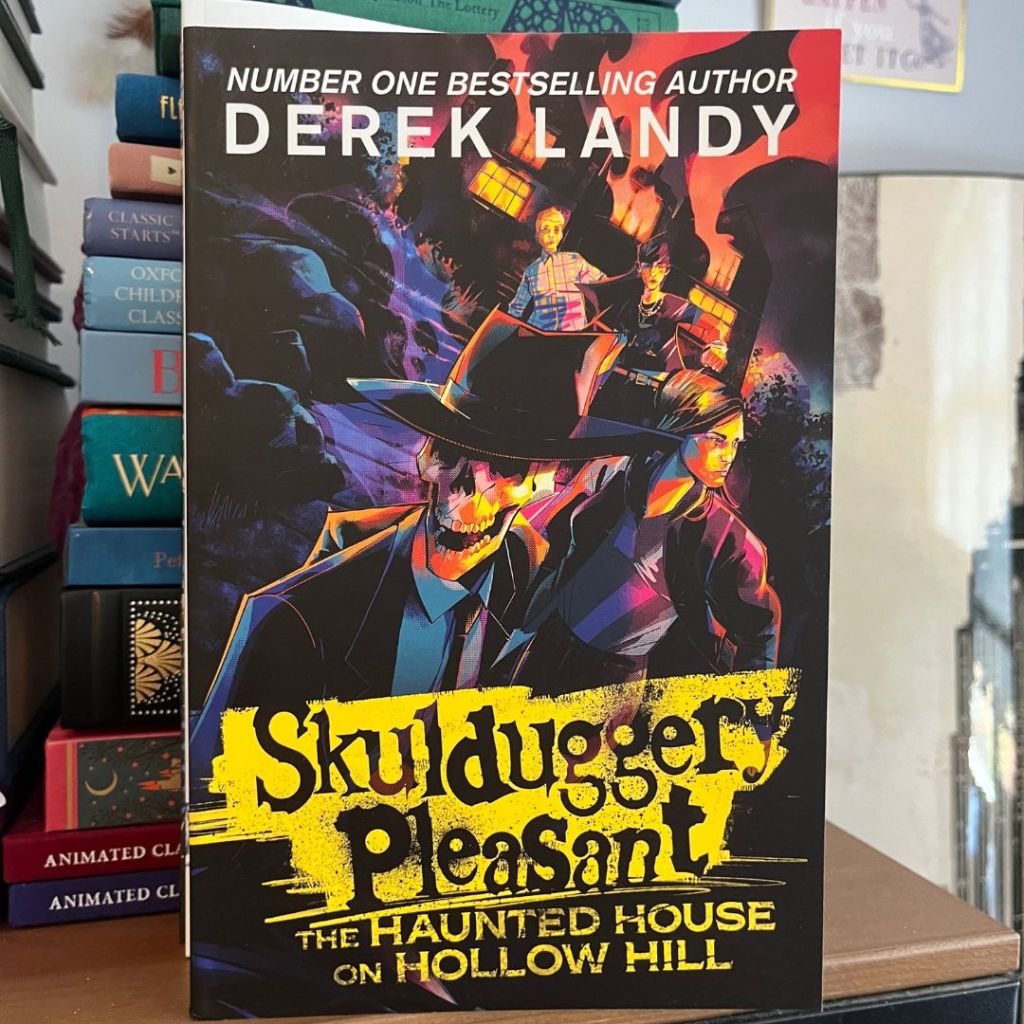
The Haunted House on Hollow Hill by Derek Landy

A review by Kate O’Brien 

“October, crisp, misty, golden October, when the light is sweet and heavy.” ~ Angela Carter 

I am currently relishing in the crisp days of autumn where everything glows a little bit golden and orange. It has been an extremely busy few weeks, but I am excited about sharing some Spooky Season books and movies as we get closer to Halloween. 

I am kicking off this year’s Spooky Season themed discussions with my review of Derek Landy’s latest book. The Haunted House on Hollow Hill was published on Sep 26th, 2024. This book follows the podcast of the same name, where listeners could tune into this episodic mystery. Now the world of the Hollow Hotel has been laid out on paper and readers can explore this mystery full of twists and turns … 

Skulduggery Pleasant and Valkyrie Cain just wanted to interview Romeo Gideon, but the most haunted house in Britain should have been a clue that things would not go to plan. 

On a dark, stormy night, as a deadly killer attacks one by one, Skulduggery and Valkyrie do not have much time to find the killer as they try to survive in this haunted hotel filled with the tortured spirits of the dead. 

Before even opening the book, I was so happy to see it had so many things that I love. I am a huge fan of a dark and stormy night. It is such a simple yet effective setting. Instantly the tone is set and as readers, we are slightly on edge. 

I love the gothic element of being trapped in a spooky house with no way out and being faced with scary events that protagonists must try to escape. The setting of a home is hugely important in gothic stories because home is such a key theme in so much literature. Finding one’s home is often a huge motivator in narratives. Home is often the safe place, the sanctuary, the place where one feels they belong, so when home is suddenly the danger site, the place we want to run from, that is interesting, and haunted houses are usually really alluring, dynamic settings because they so often intrigue as well as horrify. The image of this intimidating house on the hill, it looks so scary, and yet it almost pulls you inside. 

There is a really satisfying, slow-build sensation that manifests itself very well in haunted house settings. The build from feeling that this huge, impressive house is kind of intimidating, to perhaps being awed by the place, yet there is this eerie undercurrent that something seems off, to that fear when you realise something is off, and now you cannot leave, is always really exciting and impactful in my opinion, whether you’re reading a book or watching a movie. 

At its heart, this is a murder mystery. If you take away the supernatural elements, this plotline would have worked fantastically well as an episode of Murder, She Wrote, and I think fans of Agatha Christie would enjoy this book even if they were not fans of the Skulduggery Pleasant series. This book stands alone. 

Readers who love the Skulduggery and Valkyrie dynamic will be glad to see that this book is filled with their usual banter as Derek Landy once again expertly weaves humour into his plots despite the pair investigating serious crimes. 

I think the fact that this story was first introduced on a podcast is quite fascinating, as personally I like seeing how stories expand into different forms of media. There are many different ways to tell a story, and I think having the ability to not only read this story, but to listen to it as well, is great. Listening to a podcast is quite different to reading words written on the page. I haven’t listened to the podcast myself yet, but I imagine it would be lots of fun to hear these characters be brought to life, and based on the setting and the tone, I imagine it would be quite atmospheric, an ideal listen for the month of October if you want to fully embrace Spooky Season. 

As the plot evolves and more twists and turns play out, the story does become more complex and because there are lots of characters in the fray, at later parts of the book, I do think that reading the words on the page would make it easier to keep track of everyone than it would be when listening, however that is just a personal thought and one that I have before listening so I could change my mind. I do plan to listen to the podcast too, because I am eager to see if the story feels different when listening after reading. 

I really enjoyed this book; it was a fun October read. I am a fan of the world of Skulduggery Pleasant. I think Landy is a fun writer, he always has this knack for making plots feel very big and perhaps a bit wild as there are so many twists and turns, but he will ground it again because a detail that may have felt minor at the time has come up again and you see that Landy laid that foundation much earlier and now it has come full circle. I would describe him as a very visual writer, because reading this book and knowing it is possible to explore this story in the mode of a podcast as well made it really easy to also visualise this story. As I said earlier, I could visualise the Murder, She Wrote episode, and personally I enjoy when books feel cinematic as then it is easier to picture the world that is being built. 

If you like ghost stories, if you like murder mysteries, if you are a fan of stories that take place in one setting and there is a time crunch, then this book is one that you need to add to your bookshelf this October. I would recommend The Haunted House on Hollow Hill by Derek Landy to readers aged 13+

Make sure you stay tuned on Instagram @katelovesliterature to see what is coming up next!

Featured

Fahrenheit 451 by Ray Bradbury

A book review by Kate O’Brien. 

Can you imagine a world where books are deemed valueless by society? Can you picture living in a world where no one asks questions, where even walking outside is deemed suspicious? Can you imagine the chaos of what would happen if firemen were no longer heroic figures who put out flames and instead, they lit houses on fire instead? The scary thing is maybe we can picture this world. Ray Bradbury brings this world to life in Fahrenheit 451.

Guy Montag is a fireman. He has always been a fireman. His father was a fireman, his grandfather was a fireman, and these days it is almost like his hands move by themselves, pouring kerosene and lighting matches as though he has no part in the action. He is happy to be part of the world that never reads until he is not. Guy’s mindset begins to shift when his young neighbour Clarisse awakens a long-forgotten part of his mind, if it was ever awake at all, the part that likes to think, by asking a few questions. Then one day, a horrific fire forces Guy to admit that his hands do not move of their own accord. He does indeed start fires, he burns books and with them, he burns curiosity, he burns access to information, he burns wonder and stories until he can no longer burn anything anymore. Maybe he should take a look inside these books, maybe he should see what all the fuss is about, maybe he does not wish to be a fireman anymore. 

Fahrenheit 451 is rather bleak, and it explores heavy themes such as conforming vs questioning, the individual vs society, emptiness vs meaning. This dystopian book may be desolate and at times it is quite dark, however it does end on a hopeful note, one that notes the resilience of humanity after exploring how cold humanity can become. 

This book is about book burning, but not in the way that one might expect. Fahrenheit 451 is not about certain groups of people burning and banning certain kinds of books, this book is about a world where all books are deemed worthless. Fahrenheit 451 presents a world in which all emotions aside from happiness are repressed. You cannot have too many thoughts, you cannot have conflicting ideas, you cannot know about any dangers or sadness because none of those things are fun. Go speeding in your car, have walls of television, have constant media playing through earbuds, even when you sleep, escape all thoughts, escape all reflection, and just have fun. All fun, all the time should be great, shouldn’t it? We may think so, but within all this fun, within all this constant, relentless distraction, there is nothing but cold, empty, misery. 

I really enjoyed this book, despite it being more on the bleak side of the reading scale. 

I have always been in a position where access to books has never been a question. I have always been able to read anything that I wanted, and I recognise that this is a privilege. It is easy to take books and access to all kinds of books for granted sometimes, which is why I felt that Fahrenheit 451 was an especially important read. I would recommend this book to readers aged 14+. 

I had the opportunity to discuss this book even further alongside my podcast co-host Seán, and if you are interested in the themes I mentioned up above, you can listen to episode #04 of Your Book or Mine? now on Spotify. 

#JoinTheBookClub

Featured

Carmilla: Early Vampire Fiction

A book review by Kate O’Brien

Would there be Dracula if there was no Carmilla? 

A dark and sensual story, set in an old castle in a dark forest, always sitting under dreary, grey skies. 

What could be a better October read? 

Young Laura lives with her retired father in the Styria forest. All is picturesque until an unknown house guest arrives. Carmilla is myserteous and beautiful. She spends most of the day asleep and her moods can be unpredictable. It appears that she and Laura have met before, in a dream that Laura had as a child. But was it really a dream? 

Not long after Carmilla’s arrival, young girls who live near the castle have started to die, seemingly from unknown causes. 

The story goes on, narrated by Laura, we follow her first-person account of what it was like being in a vampire’s gaze. Each page is filled with desire and dread, and dark secrets eventually emerge. 

It was interesting going into this book knowing that Carmilla is a vampire. Despite never having read the book before, I knew that it was an early work of vampire fiction, and I knew that the story predated Dracula, so I feel that perhaps some of the suspense was dampened. I’m sure it would have been thrilling to read this book when it was first published, when vampire traits were not so culturally established. The mystery of Carmilla’s character would have been heightened if I didn’t know anything about her before reading. 

This didn’t hinder my enjoyment of the book, it is just a thought I had when preparing to write down my thoughts. 

There are many roads that one could go down when discussing Carmilla. 

The book dives into important key themes such as sexuality, specifically female sexuality as Le Fanu presents a sapphic relationship to readers in a way that is extremely straightforward for the time that this work was published in. I would argue that vampires have an established reputation as being very sensual figures, and I think that you can see this trope being carved out in Carmilla because the act of draining someone’s blood is presented as an act that always combines pain and pleasure. Carmilla chooses beautiful young women to prey on and she enjoys biting their necks and sucking their blood, and Laura in particular, enjoys the feelings even though she is sometimes unnerved. The other major theme that this book presents is the idea of extreme class divides. 

Le Fanu takes the idea of the rich “feeding off the poor,” to a literal place. 

I want to talk about the character of Carmilla specifically, because in so many ways she is a significant literary figure that represents so much power, but she is also a villain. I found this duality the most interesting when I was reading the book. 

When you consider the gender roles and the strict societal rules of the 19th century, it is easy to look at Carmilla and identify her as a female character who defies the patriarchy. Due to her immortality, she is powerful all by herself. She comes from an aristocratic background yet she did not have to marry or have children or continue any sort of bloodline. (Pardon the pun). She uses her attractiveness to her advantage. People, (men) welcome her into their homes because of her status and because of her beauty, and she is able to take advantage of the fact that people do not see her as a threat. She is also completely unapologetic about her sexuality. There is nothing repressed about her sensual acts or her expressions of desire. 

In ways she reminds me of Milady de Winter in The Three Musketeers, yet Carmilla displays absolutely no concern towards the poor. In fact, she sees them as simply meals. She goes as far as scolding Laura for showing empathy at the funeral of a peasant girl who died due to an “unknown illness.” Carmilla states that she doesn’t concern herself with “peasants.” 

There is a disconnected attitude displayed towards the poor in general in the novella. Laura and her father describe themselves as “middle-class,” yet it is clear that they live a luxurious life in their castle. They also do not worry at all about the mysterious illness that is killing young girls, because even though they do show some sympathy towards those girls, they never see themselves as being under any threat. They view the mysterious disease as an illness that peasants simply spread among themselves. This disconnected attitude highlights how privilege creates bubbles for people to live in. Laura is not as vicious as Carmilla, who views herself as superior due to her aristocratic lineage, but she does recognise that her father’s position protects her in many ways. Carmilla’s comments at the poor girl’s funeral appear even more callous when you learn that it is she who is feeding on those young girls. There is also the implication that people were not too concerned about whatever was plaguing the villages until Laura started displaying symptoms. Now a middle-class girl is unwell, so doctors must try harder. 

It is very telling when you see some people’s lives being presented as disposable. 

It is important that we stop and ask why that is? It is also a theme that can be found in other works. 

In Jekyll and Hyde, the musical, the rich are terrified when Hyde starts murdering people in their social circles, but they are relieved later when he kills Lucy, a prostitute, showing that they don’t mind that there is a vicious murderer still on the loose, as long as he is not targeting them. 

If one removes the vampire element for a moment, it is the same when a poor person gets sick in a period piece vs a rich person. The rich person is taken seriously, and often provided with the best care. A poor person may not be able to receive any medical attention at all due to money, and there often isn’t much sympathy given. It is an example of how anyone can get sick, but not everyone can recover in the same manner and this can be due to finances alone. A rich person may arrogantly assume that an illness will not impact them, but if it does, they have a better chance at surviving due to money and care. 

I’m a big fan of the supernatural elements of Carmilla. I don’t wish to spoil the ending, but I will say that I enjoyed the ambiguity. The idea that even though a figure has been “beaten,” but they may not be fully gone is always intriguing. This idea suggests that danger could return at any time, so the “safety,” found at the supposedly happy ending is always sitting under threat. I particularly like this because I think it perfectly illustrates that gothic trope of safety being subverted. 

I would recommend Carmilla if you have not already read it. It is a great read that is not too long and the suspense builds beautifully. It is a literary classic for a reason. Even if vampire fiction is not usually your cup of tea, it is a dark and engaging tale that will captivate readers, and it is interesting to see early works of vampire fiction before mainstream tropes were commonly established. 

Be sure to follow me on Instagram if you don’t already for all updates about katelovesliterature.com 

Featured

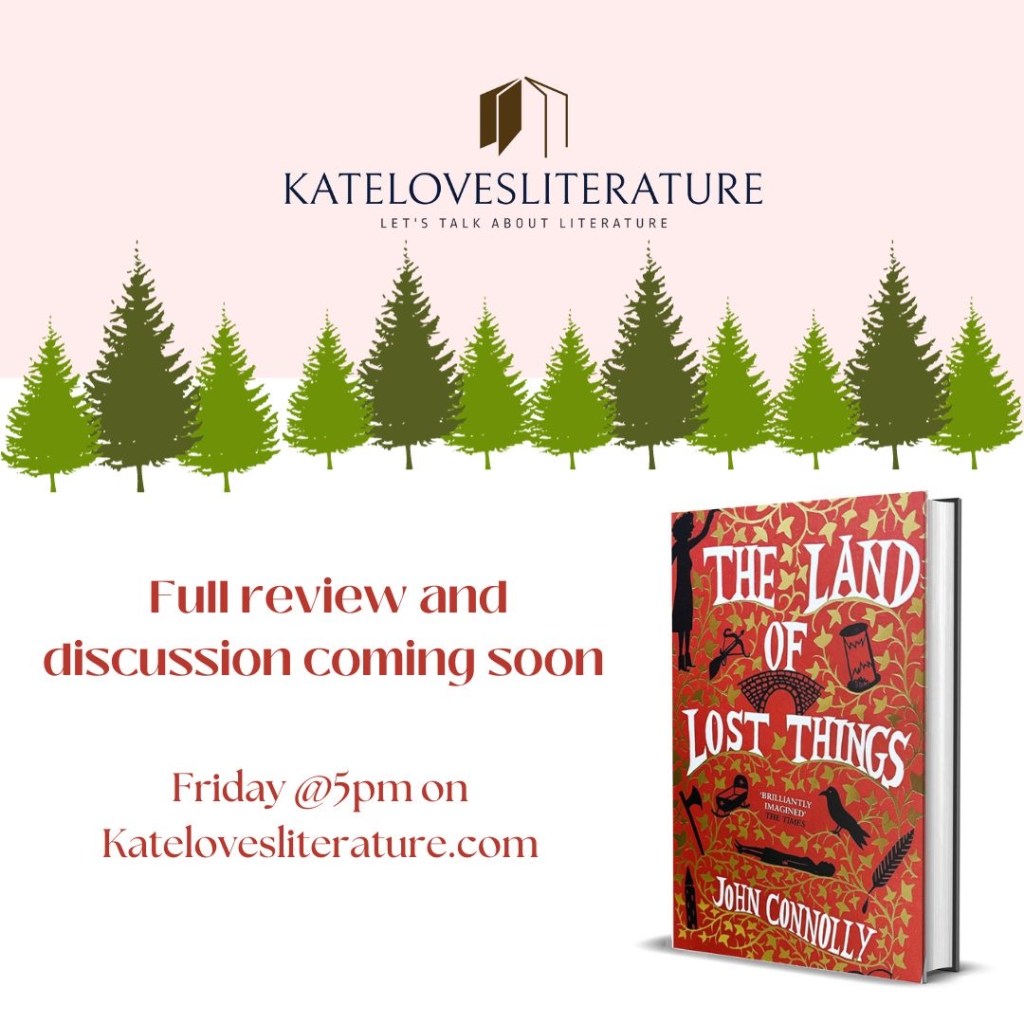
The Land of Lost Things by John Connolly

A review and discussion by Kate O’Brien. 

When I read the first of this series, The Book of Lost Things, I said it was a nod to dark and twisted fairy tales, ideal for those who enjoy anything a bit Grimm. (Pardon the pun.) 

I eagerly awaited Connolly’s sequel. In fact, I read this entire book in a four-hour sitting. 

I was enthralled, happy to read a new tale, and happier again to see old favourites appearing once more. 

I’ve taken some time to sit with this sequel, to think about it,  to try to answer the famous question of which book do I prefer? 

I prefer the original. Predictable, I know, but it is true. The world that John Connolly created in the first book was scary and intriguing. Poignant and emotional. Returning to it was interesting, but without the thrill of the complete unknown. 

The Land of Lost Things introduces readers to a new protagonist, this time not a lost child, but the mother of a lost child. Ceres is stuck, her child Phoebe is comatose and has been since the car accident. The bright, curious child she once was is becoming more and more like a distant memory to Ceres, who fears she may never see that lively child again. 

I will say now that this book, similar to the first book, contains some very sad and dark themes about sick children, about losing children, and about the grief, fear, and anger that parents carry while trying to stay hopeful. It is a sad read, so not for readers who want some lighthearted escapism. 

When Ceres allows her worst fear to be uttered aloud – that perhaps things would be easier if Phoebe was out of pain, she finds herself chased into the same mysterious land that David found himself in when he wanted to escape his new life with his stepmother and stepbrother in the first book. 

Ceres finds herself sixteen again and she must face her fears and find her way back home, back to her child, and she does this with the help of familiar faces. The idea of being a teenager again and how horrified Ceres is by this is very funny. It’s a really interesting concept because Ceres is stuck in her teenage body, but she still has all of the knowledge she has gained over the years and as a mother. So she’s almost this ideal that some strive for. Many people wish for the carefree days of their youth back, or perhaps they wish to look as they did when they were younger, but with all of the knowledge of hindsight. Ceres is in this position, yet the idea of placing her back in her teenage body when she is in a fairy tale realm worked really well because the character tells readers that sixteen was her worst year. She hated it. She felt completely insecure, powerless, and vulnerable, and placing her back in that place works really well as it visually mirrors how she feels about the ordeal she is facing with her daughter. Once again she feels angry, scared, and utterly powerless. She cannot do anything for her child aside from hope that one day she’ll wake up, all she can do is hope she is not in any pain. 

While I would recommend reading The Book of Lost Things first, it is important to note that this book can be read by itself. Connolly is a very vivid writer, it is clear that he is an avid reader of fairy tales, and he understands the way that they can leave a lasting impact on readers. There are certain stories that we carry with us for life. They can bring us an escape and they can bring us hope and wonder in times when we need them to do that for us.  In this story, Connolly expresses an appreciation and a love for literature. The importance of literature is a key theme alongside the  bleaker themes of fear and grief. Books can go out of print, but they can’t be forgotten if they’ve been read, if someone is talking about them. Books live on in so many ways, and as Connolly rightly states, “It’s not the people who read books you have to worry about, but the people who don’t.” 

I believe that I said the same thing about The Book of Lost Things, but the same applies for this book, ultimately it is a quest. At its core, this story is a quest, almost an epic quest I’d argue as Ceres must journey across a new realm, facing fears and facing dangers, all in order to achieve her ultimate goal, which is of course to find her way home to her child. 

In terms of writing style, Connolly is very descriptive, very vivid, and almost cinematic in the way he paints pictures with his words. The story moves at a fast pace and it is full of information, in fact at times there is almost too much going on, but that tends to happen when stories are set in fantasy worlds. Connolly is also fond of ending chapters with a cliffhanger, so be prepared to be in suspense for a while when reading. Without spoiling the ending of this book, I will say that I preferred how the first book ended. It felt more complete than this ending. That is due to the fact that David’s arc ends very differently, we are given a lot of closure as readers about David’s arc, whereas in this book, Connolly leaves readers with an unknown, although it is a hopeful unknown. 

The ending suits the book perfectly. The tone and how it all ends is very apt, and the way the story ends is the entire point of the book, but I will argue that David’s arc and his ending with more information makes for a more satisfying end. 

Warning – Spoiler – Skip This Section If You Do Not Want To Know The Ending 

The book ends with Ceres returning to her daughter after chasing Lady Death, who was hovering over her away. Ceres is scared, she does not know if things will be okay, but she has hope, and she does not want to give up her hope. She begins reading to Phoebe, and after months of no signs of anything at all, the book ends with Ceres feeling one of her fingers moving. 

That’s it. We don’t get anymore information. We don’t know if Phoebe will be okay. We don’t know if she’ll make it after everything that Ceres has been through. People critique “fairy tale endings,” and “happily ever afters.” Perhaps it would have been too obvious if Phoebe woke up at the end. The fact that we are left with a small sign of hope but also with uncertainty very beautifully makes the point that Connolly has been setting up throughout the entire book. Sometimes all we have is hope, and hope is worth holding on to. The ending makes sense and fits the overall tone that Connolly has created, but personally I enjoy endings that feel more complete. I’d have been happier if the book had have ended with her eyes opening and that’s it. No big reunion, no dialogue shared, just her eyes opening before the end. A small finger movement is a hopeful sign, and perhaps Phoebe went on to be okay, that’s up to us readers to imagine. 

Spoilers Over.  

For fairy tale lovers, for readers who enjoy fantasy and adventure, The Land of Lost Things is a must read. There are some wonderful classic fairy tale references that readers with keen eyes will be delighted to spot! For those who love stories that are on the darker side, this book is for you as Connolly is not afraid to lean into the dark and grim. 

Make sure you follow me on Instagram @katelovesliterature if you don’t already to stay up to date on all things that are #comingsoon on katelovesliterature.com 

Book Chats: Interviewing Dr Claire Hayes.

Book Chats: Interviewing Dr Claire Hayes. 

A book discussion by Kate O’Brien. 

I am very excited to share this news! So excited, in fact, that I have made a schedule change. 

If you follow me on Instagram @katelovesliterature then you will have noted that I said that this week I would be discussing poems for the summer season on Katelovesliterature.com. 

That piece is #comingsoon so stay tuned! 

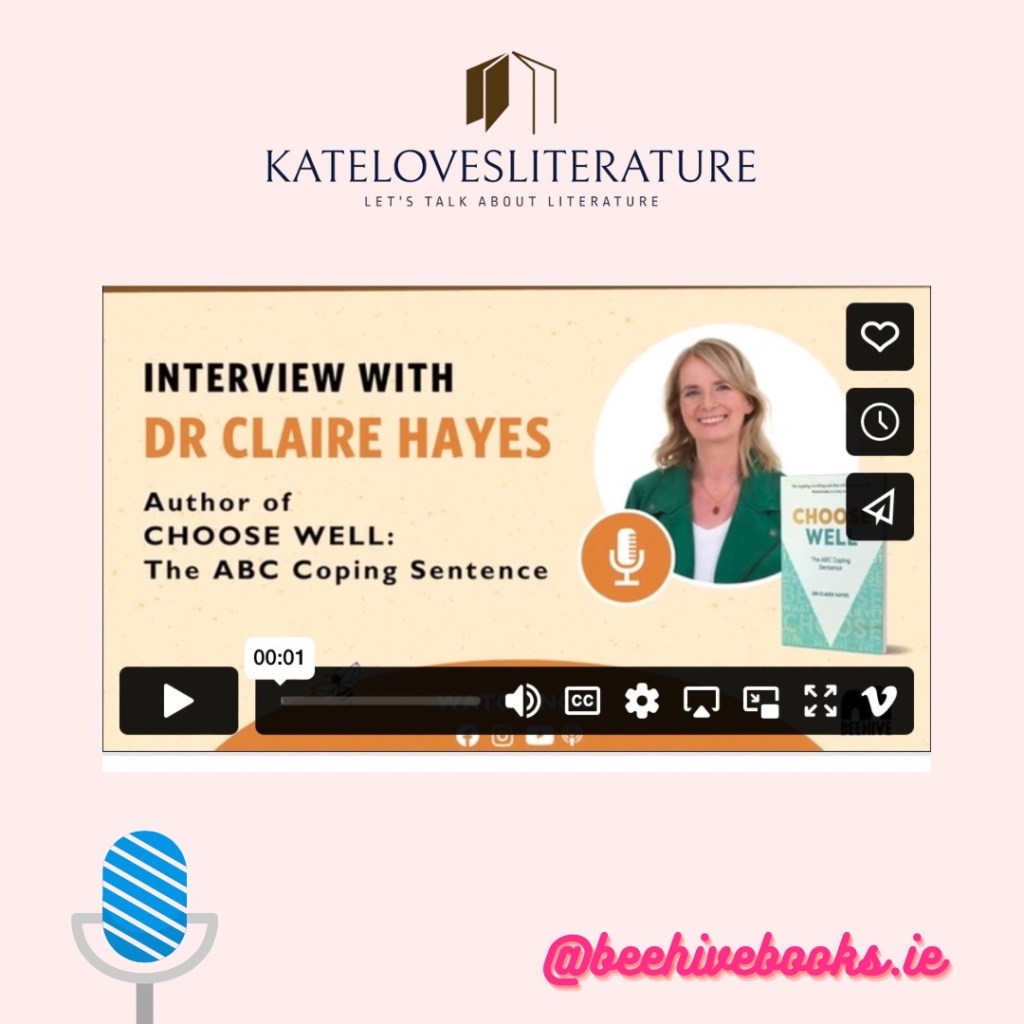
I’m delighted to share that I had the opportunity to interview Dr Claire Hayes, author of Choose Well: The ABC Coping Sentence. This is her latest book that has just been published by Beehive Books @beehivebooks.ie 

Dr Claire Hayes is a consultant, clinical psychologist, and in her newest book Choose Well: The ABC Coping Sentence, she provides readers with simple and effective tools that are designed to help people manage stress and anxieties. Her book is short and sweet, and very easy to read as her language is simple and succinct. This is an excellent book and I believe it could be a really helpful tool when used to help someone acknowledge the stress they are feeling, identify what is the cause of that stress, and then use that knowledge to find new ways to cope and deal with that stress. This book is a particularly great read for any students and parents/guardians of students who are sitting their Leaving Cert Examinations as these exams are usually one of the first big stressful situations that young adults face, and due to this book’s simple, straightforward style, this book would be a brilliant starter book when it comes to introducing mindfulness techniques to young adults. The techniques they will learn about in Choose Well: The ABC Coping Sentence, are techniques that they can carry with them as they enter adulthood. For those of us who have left the Leaving Cert behind many years ago, this book is still a fantastic read, as we are never too old to learn to take better care of our mental health. For example,  when I was reading this book in preparation for my interview with Claire, I found myself really enjoying her tips on how to reframe certain thoughts in more positive ways. 

Dr Claire Hayes was a delight to chat to. Kind, enthusiastic, and full of great advice all about coping with stress and anxieties, and of course, it was brilliant to hear about some of the behind-the-scenes aspects of the book writing process. 

I loved conducting this interview and I hope that you’ll click the link below and tune in for yourselves! Thank you so much to Dr Claire Hayes, and to Beehive Books. 

Click on this image to be taken to the full interview!

*Please note – this current discussion on Katelovesliterature.com is not an AD and not sponsored. I’m simply sharing something that I really enjoyed doing.* 

I hope you’ll enjoy my full interview with Dr Claire Hayes, author of Choose Well: The ABC Coping Sentence. 

For more info about Dr Claire Hayes, be sure to visit her website https://drclairehayes.ie/

To grab your own copy of the book, you can visit https://www.beehivebooks.ie/ 

A Lifelong Love of Literature.

A book discussion by Kate O’Brien. 

This week’s piece is a little bit different to what I usually publish. 

Today I had the pleasure of attending the 2023 Children’s Books Ireland Awards that took place in Merrion Square. I am a book reviewer for CBI & I absolutely love attending the CBI Awards because they are such a lovely event. The awards celebrate & encourage a love of reading in young people as well as acknowledging & celebrating the amazing writers who create gorgeous books for younger readers. It is an honour to attend & I had a fantastic time. 

I’ve been looking forward to the CBI Awards for a while now & so I felt inspired to put together a shortlist of some of my favourite books from childhood. I always talk about how I believe that the books we read when we are young open up the world of literature for us, & a love of reading as a child can grow & develop into a broad, curious, love of literature as an adult. If you’re like me, that childhood love can grow into a passion, so much so that it can even become your job. I consider myself extremely lucky because I do work in a literary field & I get to do what I love every single day, but I wouldn’t be doing what I do now if I was not an avid reader & if I had not been encouraged to read everything & anything that I could get my hands on. 

I have quite the library at home, which you will see snippets of fairly often if you follow me on Instagram @katelovesliterature – I have books that were given to me as presents when I was a toddler so it is clear to see that some of these books have been read again, & again, & again. 

I thought it would be fun to talk about the books that lead to a love of literature – some of them anyways! This is not a review, this is not a list of recommendations although if this shortlist inspires you to pick up a book then happy days, but my intention behind this week’s piece is to simply talk about six books that I loved to pieces when I was a young reader. 

I’m going to talk about six books that I absolutely loved in no particular order. 

Matilda by Roald Dahl. 

I adored Matilda. This book was published in 1988 & I believe that I would have read it from the age of six or seven upwards. I remember loving it because of the way Matilda triumphed over the adult bullies in her life. I remember hoping to have a teacher as absolutely lovely as Miss Honey. 

When I reread the story of Matilda as an adult, I find it very moving. It is a story that captures the helplessness that one can experience when we’re young because as children, we are at the mercy of the adults around us. Some adults do have the attitude that because children are smaller & younger, they don’t matter & these adults treat them however they please & I think this story is still relatable in the way that it accurately describes the way children envision what being an adult will be like. When you’re little, in school, being bossed around, the idea of growing up & getting to make your own rules feels like a dream. I still wish that more teachers would be like Miss Honey. 

Cinderella …Countless Versions. 

I cannot tell you how many versions of Cinderella I own. I have the Grimm version, the Perrault version, I have a Walt Disney book version, I have collections of fairy tales for children that include Cinderella, I have illustrated editions … you get the picture. To this day Cinderella is my favourite fairy tale. I adored it when I was a little girl. It has always been a story about hope & magic. I loved when the tattered rags became a beautiful ball gown & I think I will collect editions of this tale for the rest of my life. I know that it has faced criticism, as many fairy tales have, but I truly feel that so many critiques miss the point. This is a tale about a young woman who survives horrible, abusive conditions. It is not about waiting for a Prince to come, or about magic saving the day, it is a story about a kind person who is facing hardships but she does her best to remain kind anyways & when all hope is lost, magic allows her to go to the ball & have some well-deserved fun. It is magical & I think that sense of pure escapism is what I’ve always loved most about the tale of Cinderella.  

The Secret Garden by Frances Hodgson Burnett. 

I received a hardback edition of this book when I was seven & I absolutely loved it. I read this story countless times. I fell in love with the moors & the curiosity that drove Mary to need to know what was behind the hidden door. The idea of having a secret place is what always stood out to me when I was a younger reader. I loved the idea of having a beautiful place that only I knew about & I remember the descriptions in this book really standing out to me when I was younger. There is a moment where Mary is wandering through the many halls of the house & I believe she loses her way or almost does, & this moment stood out to me when I was little. I do remember being worried for her at the idea of her getting lost. I wanted her to find her way back to her room. 

The Velveteen Rabbit by Margery Williams. 

This book still makes me emotional. When I was little I had a pink, velveteen rabbit who I loved very much & so this story always made me think of that rabbit. The idea that the velveteen rabbit was real all along is an idea that I still love. In many ways I think this story can be used to help explain why children’s wonder is so important. At the end of this book, the velveteen rabbit becomes “real,” and by “real,” the book means that the toy rabbit becomes like an actual animal rabbit with fur & whiskers etc. The rabbit then lives with other rabbits in the wild, but the child considered this rabbit “real,” all along. So the question is posed – when did the rabbit really become “real?” – when the rabbit was no longer a toy, or was the rabbit always “real,” because of the child’s belief? Personally I think the rabbit was always real, because it was a source of joy & comfort to the child. The child cherished the velveteen rabbit & so it was always real. 

Wonder is like that. We believe in so many things when we’re little & even though they may not be “real,” they are real for a time. This is a very charming story that I still love today. 

Guess How Much I Love You bySam McBratney. 

I’m not sure if the phrase “I love you to the moon & back,” originated in this book, but this is where I always remember it from. This book is absolutely charming & filled with the most lovely watercolour illustrations. I believe that this book was read to me very often & I continued to read it again, & again on my own. This is a book that is about the bond between a parent & their child. This story is filled with beautiful, grand expressions of love. It is a very sweet tale, a very simple one, yet I love it all the same. It is definitely a book that I hope to read to someone someday. 

A Series of Unfortunate Events by Lemony Snicket. 

One of my older cousins loved this book & I remember my mam buying it for them. 

Eventually I read it myself & I loved it. I couldn’t stop turning the pages. I probably read it for the first time when I was seven or eight, or even nine, & I doubt I would have used this word then, but looking back on it now, I remember thinking that this book was “darker,” than anything else on my bookshelf. This book was the first book I read that was a black comedy. 

This book featured adults who were actively seeking to harm children, these orphans couldn’t seem to catch a break. This book (& later books in the series), would have been one of the first mystery books that I read. Today I study literature so today I am able to recognise the gothic elements of these novels, I can discuss in much more detail about how important these texts are because they highlight how some adults can blatantly see that wrongdoings are happening, but instead of helping, they choose to look the other way. I think this book is an important one for young adults in particular to read. Sometimes, some adults do choose to look the other way instead of helping, & while this is a hard lesson, it is one that everyone needs to learn. Today I am able to explain properly how I find Snicket to be an incredibly detailed, evocative writer, but back when I was nine, I didn’t have the broader, literary vocabulary that I luckily have today. All I remember thinking was that this book stood out, it was scarier, darker, it felt more “grown up,” when I was younger & I had to keep turning the page. 

There you have it, six books I loved when I was little. This is not an objective list, I’m not highlighting in great detail why I think these are great books, if you feel inspired to read some of these texts then go right ahead although I was not supplying them as a list of recommendations. I really just felt inspired to go through my collection, pick out some books that were clearly well loved by my younger self & tell you about them. As I was putting together the above list of six, I do feel like some common themes emerged. All six books mentioned above include some sort of escapism & magic, all of the above stories, aside from Guess How Much I Love You perhaps, include some form of a character or characters feeling as though they don’t belong & all of the stories listed feature a protagonist finding a sense of belonging/home after being on the outside so clearly when I was younger I enjoyed magic, I enjoyed adventures, & I enjoyed that cosy feeling that comes with the sense of belonging. 

I’d love to hear what your childhood favourites were so feel free to leave a comment below & stay tuned as there is lots more to come here on Katelovesliterature.com

The Book Of Lost Things: Dark, Twisted, & Utterly Moving Fairy Tales.

The Book Of Lost Things by John Connelly.

A book review by Kate O’Brien.

This book was published in 2006 by Hodder & Stoughton.

I have the beautiful, illustrated edition that was published in 2017.

The illustrations were created by Anne M. Anderson.

The Book Of Lost Things is a dark & twisted fairy tale written in the third-person that tells the story of David, a twelve year old boy who is mourning his mother. David’s world is turned upside down when his mother dies & his father remarries another woman very quickly. Not only does David have to get used to his new stepmother & a new home, but he also must adjust to having a new baby brother. David understandably really struggles to accept his new home life as he desperately misses his mother & he feels that his father moved on too quickly. David fears that his father does not miss his mother at all & he’d rather reinvent life with his brand-new family.

David finds solace in his books as he & his mother shared a passion for reading, but David’s world changes & he learns that stories are not always what they seem when the fictional world of his beloved fairy tales bleeds over into his reality. When David finds himself stuck in a fairy tale of his own, he must go on a journey to learn that good & bad, right & wrong are not always so straightforward.

I have always stated that I find age ratings difficult to apply, because a child’s reading level does not always adhere to their age & some children are more mature than others so they might be interested in, & able to handle more mature topics earlier than their peers, however I will say, & I do not say this lightly, that The Book Of Lost Things is not a children’s book. It sits on the line between being a YA novel & just a novel, full stop. I do think that fans of YA narratives would enjoy this novel as it does present tropes that are typically presented in YA narratives.

David feels like an outsider & so he goes on this journey believing that he is the outsider. In many ways, he does fulfil the archetypal YA role of “the chosen one,” there are some dystopian ideas at play because the fairy tale land that David is facing is in danger, but in many ways this novel steps beyond the realm of YA tropes. One example is the adults in this novel are not useless. The adults that David encounters play a very important role in shaping his journey as ultimately, I would argue that The Book Of Lost Things is a coming of age story & it particularly focuses on David maturing & growing from a young boy into a man.

The reason I say that this book is not a children’s book is because there is a very dark, & at times a very sinister undertone present throughout the book. This book deals with very mature & violent themes that some readers may find very upsetting and/or disturbing. This book focuses very heavily on lost & missing children, & there is a focus on the fact that there are people who do have ill intent & wish to harm children so while this book tells a very moving tale, it is not one for younger readers.

In terms of style, I would suggest that this novel is somewhat similar to A Monster Calls by Patrick Ness. Both texts feature a young boy who is becoming a man. Both boys are mourning their mothers, & both boys learn through stories that life is more nuanced than we think it is when we’re young, & right & wrong is not always so clear. Storytelling is a huge part of both texts too, as both boys have stories told to them as a way to help them grow & learn. At times I felt that David came across like he was clearly a twelve-year-old whose perspective was being written by an adult, yet at other times, he felt extremely realistic & his feelings & actions matched his age & his struggles which made him very easy to sympathise with & root for.

I think that fairy tale lovers especially will really enjoy this book because it features elements of classic fairy tales such as Snow White, Rumpelstiltskin, Hansel & Gretel, but John Connelly adds his own spin to these well-known tales & there is one twist in particular that I won’t spoil, but I thought it was really clever.

The key themes explored in this novel are ideas of overcoming grief & anger, maturing from boyhood into manhood, family & a sense of belonging, & most importantly, the key theme of this book in my opinion is the lesson that right & wrong is not always as black & white as we might assume it is & as we grow, it is up to us to learn how to see beyond our emotions & make decisions that are right for us, but that are also right for the people around us. This book really illustrates how the choices that one person makes can really impact, & even really hurt another person & if we choose to do something knowing that it will really hurt someone else then we must be able to face the consequences that come with that decision.

Overall, I really enjoyed this book & I would highly recommend The Book Of Lost Things

By John Connelly. It was an exciting, poignant read that felt like a homage to classic, dark, & Grimm fairy tales. It was a very moving tale & I was highly invested throughout. I read this entire book in one evening as I kept having to turn the page, so I would absolutely encourage readers to pick up this book but be aware that it does feature some dark themes & topics that some may find upsetting & it is not a book for younger eyes.

Stay tuned as there is lots to come here on Katelovesliterature.com

Be sure to follow me on Instagram @katelovesliterature if you don’t already.

You will see all the updates about what is coming up.