December’s Book Of The Month.

Hello everyone. I hope that you are all keeping well. I am a little late announcing this month’s #bookofthemonth and that is because it has been an extremely busy few days and I was still deciding which novel I wanted to sit down with in December.

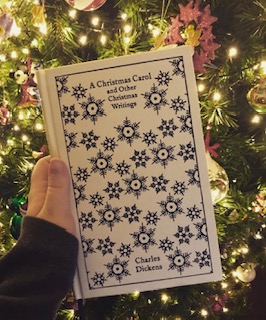
I have made my choice and if you follow me on Instagram (@katelovesliterature), then you’ll have just seen my latest grid post, revealing that December’s #bookofthemonth is A Christmas Carol by Charles Dickens.

I have chosen this classic text because I love the works of Charles Dickens. I have studied the work of Dickens in great detail, I have written a dissertation about his works and A Christmas Carol is one of my favourite texts. I think it is a very important text. I think it is a text that everyone should read at least once. The text has become somewhat synonymous with Christmas time, this is something that I will discuss in my review, along with all of the other reasons why I love this text at the end of the month.

So please feel free to read along with me and enjoy the work of Dickens this December.

Have you read A Christmas Carol? Are you a fan of Dickens? Let me know.

Kate xo.

My beautiful Christmas edition of A Christmas Carol by Charles Dickens.

The Secret Garden.

Hello everyone. Welcome to November’s Book Of The Month discussion. 

As you know, November’s #bookofthemonth is The Secret Garden by Frances Hodgson Burnett. 

I have really enjoyed being nostalgic in November and going forward I will be reading more childhood classic novels because I think it is really interesting to reread these books again with adult eyes. 

Be sure to keep an eye out because I will be announcing December’s #bookofthemonth very soon, and seeing as it is coming up to Christmas, I have chosen a Christmas classic. Can you guess what it could be? Stay tuned to find out. 

The Secret Garden by Frances Hodgson Burnett was first published as a book in 1911. 

The plot follows the young Mary Lennox who must adjust to living in Yorkshire after she loses her parents to cholera. Mary is a sullen child, and she finds the move from India to Yorkshire very difficult. Mary is very lonely and very unimpressed with her new home until one day a little robin in the garden leads her to a door that does not have a key. Mary becomes determined to find a way in, and when she does, the secret garden becomes a place of solace for Mary and her newfound friends. As the novel goes on, Mary begins to become a happier child, one who is finding love, happiness, and a sense of belonging in her new home. The house is filled with secrets, and Mary learns a lot as the story plays out – however I will not be spilling the secrets here, if you wish to know what happens then I would highly recommend picking up this classic. 

I am going to talk about the writing style in The Secret Garden. Keeping in mind that this text is a piece of children’s literature, I think that one of the reasons that this book is such a classic work of children’s literature is because Frances Hodgson Burnett writes in a way that I think is very appealing to readers, especially to younger readers. Burnett has written this novel in the third-person, and the narrator of the story is privy to all the details of what is going on in the house, and this is very important as it is a layered story with many characters so having a narrator who acts as an authoritative figure who is explaining in a clear way what is going on, keeps the plot easy to follow. Burnett also uses quite short, direct sentences but there is still lots of descriptive language in the book as Mary is taking in her new surroundings and analysing what she thinks of them. I really like this writing style because Burnett’s use of descriptive language creates beautiful imagery, but the shorter, direct sentences keep it from being too heavy and too dense, and again, I think this is great for younger readers because they can take in all of the wonderful descriptions without facing paragraphs and paragraphs of writing that can feel like too much.

 I think that I would call The Secret Garden a romantic novel as the book paints the garden and nature, and the outdoors as places of extreme beauty and healing. Mary’s development from a sullen, sour child to a rosy-cheeked, happier one is linked to her spending time in the fresh air and in the earth. Mary becomes happier as she tends to the garden, she makes new friends, she becomes more and more settled in her new home, and this is very much tied to her spending so much time out in nature. Romantic novels place a great emphasis on the importance of nature, and on the beauty that can be found in nature, and I think that The Secret Garden does this too. I also think that Mary Lennox is an example of someone experiencing a romantic version of childhood due to her status in life. Mary is a privileged child who is experiencing a life in which money is not a concern. 

I would suggest that the book’s main theme is the idea of healing. In Yorkshire, Mary flourishes and she helps others heal from their grief too. As I said, I won’t be spoiling the plot so you should go and read it, but those of you who have read it will know that Mary is not the only character who benefits and heals from the garden being restored. There is a lot of love in this novel, and I think it has a very cosy, nostalgic tone. 

I really enjoyed reading this novel again as the last time I read it I must have been only nine years old. I absolutely loved this novel when I was little so it was really nice to sit down with it again in my twenties. There were certain parts that I remembered like the back of my hand, while others I had almost completely forgotten about. Dickon is still my favourite character. He is kind, he is fun, he is a complete nature lover. He is always outdoors, and he is always with animals. I have always thought that there was something really lovely about his character as he is such a good friend to Mary. I think that he captures a really lovely childhood spirit because he does find wonder in the smallest things, and he is even happy on the rainiest of days. 

The novel is full of very different, very well-rounded characters and I think it is the richness of the characters that makes the novel so fantastic because I would suggest that the plot itself is rather straightforward. It is easy to follow yet it is intriguing and compelling. 

I think that this novel captures a sense of wonder, and it encourages curiosity, because as I was reading, just like Mary, I found myself wanting to know what was behind each locked door so there is a sense of mystery throughout the novel too which I think is really interesting. It keeps you engaged as a reader. 

This has been my Book Of The Month discussion. I hope you enjoyed it. Overall I really love The Secret Garden. Reading the book again reminded me why I loved it so much when I was younger, and I still enjoy it now. I think it is a lovely, compelling story with many different, interesting characters who keep the reader engaged. I think that the writing style is imaginative without being overly complicated, and I think that the healing arcs that are explored in this novel are very touching. 

Have you read The Secret Garden? If so, I’d love to hear what you think. Let me know, and be sure to stay tuned because I will be revealing  December’s Book Of The Month very soon. 

Kate xo. 

.

Frankenstein.

Hello everyone. Happy Halloween. I can’t believe that it is the end of October. The month has flown by, and I hope that you have all enjoyed #spookyseason. 

I hope that you all have a fantastic Halloween, have fun, stay safe, and always beware of the headless horseman. 

Let’s dive into October’s #bookofthemonth discussion all about Mary Shelley’s Frankenstein. 

I am going to start this discussion by elaborating some more on why I chose Frankenstein as October’s Book Of The Month. Over the past few weeks, I have been embracing the Halloween spirit here on Katelovesliterature.com and I have spoken a lot about gothic literature, subversive literature, and the horror genre. 

Now, I think that it can be argued that it is easy to assume that Frankenstein fits into the horror genre, and in many ways it does because of course there have been many horror movies based on, and about Frankenstein. I think it would also be fair to say that many people would associate the name Frankenstein with the image of a monster, but I think that Shelley’s text is far more complex than being just simply a horror story. Mary Shelley’s Frankenstein is a gothic, romantic novel that presents a very layered plot that depicts some very complex and nuanced themes, which is why I decided that I wanted this text to be October’s Book Of The Month. 

In many ways, Frankenstein is a very romantic text, because Romanticism (always with a capital R), is very interested in the idea of wonder and curiosity, and in this idea of embracing the unknown and the unexplainable. In Frankenstein, it is wonder and a scientific curiosity that drives Victor Frankenstein to experiment and attempt to do what has not been done before. 

Let’s talk about form. Frankenstein is an epistolary novel. When a novel is written in epistolary form, it means that the novel is written in a series of documents. This is an interesting form to use because somewhat similar to the third-person perspective, epistolary form allows the novel to present different points of view, but because letters and diary entries and newspapers etc., can make a story feel more grounded, it could be said that using epistolary form makes the story feel more realistic. 

Another interesting thing to note is that in Frankenstein, there is a cautionary tale within the story as the writer Robert Walton is exploring in the hopes of expanding his knowledge. He reaches the North Pole where he sees a sled being pulled by a huge creature. Walton wants to find the huge creature and discover who or what it is, but instead he finds the scientist Victor Frankenstein who has nearly frozen to death in his pursuit for that same huge creature. Victor sees some of himself in Robert, and so he tells Robert his tale, which is in fact, the creature’s tale, and thus, the true plot of the novel begins. 

From a very young age, Victor was obsessed with science and experiments but his ideas were considered extremely outdated. His mother’s death caused him to bury himself in his work in order to deal with his grief. Victor explains how he excelled at chemistry and through his very intense studies of science, he discovered a way to give life to non-living matters. Victor becomes obsessed with the idea that he can give life back to a nonliving thing, and so he decides to perform an experiment, and he begins to create a humanoid. Victor selects the pieces for his creation, but he does not properly think about proportions, and even though he selected things with the intention that his creation would be beautiful, instead he creates a tall, hideous, terrifying looking creature. This creature is appropriately called the Creature, and it is important to remember to capitalise the name if one is speaking of the Creature from this point forward, for that is the character’s name. Victor is repulsed by his creation and so he abandons it in the lab. When he returns later, the Creature is gone. Now even though this is a #bookofthemonth discussion, I am not going to discuss the plot in much greater detail because I don’t want to spell out the story for those who have not yet read the book but may decide to later on. 

Let’s now talk about themes because Frankenstein presents many thought provoking themes, and the layered, nuanced themes are the primary reason why I love this text. 

The first theme is of course the notion of wonder. Without wonder, Walton would not be exploring, and without wonder, Victor would have never experimented. Both characters had an insuppressible desire to discover, to expand knowledge, to learn the unknown, and this theme is one that I love because I think it further complicates the tension between romantic writing and enlightenment writing, because romantic writing is about wonder, nature, curiosity, and the unknown. It is about the idea that not everything can and should be measured because not all things can be, like feelings for example. Feelings are very often not rational, but that does not mean they are not real. Enlightenment writing is about the idea that all questions can be answered with logic, reason, facts and figures, and if one was to think about the Gradgrind approach in Hard Times by Charles Dickens, if it cannot be measured then it cannot be real, so there is a tension between romantic writing and science, but the notion of wonder depicted in Frankenstein complicates this tension even further because I would put forward the question, can someone experiment if they have not had an idea? Would this desire to do something that has not been done before not be considered original? Does this then mean that all ideas have to be sparked from some form of creativity, highlighting the importance of creativity? 

I said at the start of this discussion that Frankenstein is a very thought provoking text and I meant it. 

An extremely prominent theme in this text is the idea of nature vs nurture. This text presents that famous question, is one born evil or made evil? A point that I would like to make before I expand on this theme, is that when I discussed The Great Gatsby, I spoke about how this text had a prominent place in popular culture because when one hears The Great Gatsby, images of grandeur, decadence, champagne and flapper dresses spring to mind, and I think it is important to mention that Frankenstein has a similar place in popular culture. Many people hear the title Frankenstein, and they think they know the story, but they do not actually know the story. Frankenstein has been adapted many times, and some versions stray away from the original text completely. Some people even call the Creature by the name of Frankenstein. I think it is fair to say that the thing that many people associate the word Frankenstein with is the image of the green, monstrous looking zombie, with bolts in the side of its neck, and it is a monster that can hardly speak, the work of a mad scientist who wanted to create such a monster. This is not the case. The Creature looks human, but it is grotesque because of how huge, hulking, and disproportionate he is, and because the parts were stolen from the dead. Another extremely important thing to note is that the Creature is very intelligent. Victor Frankenstein is not a mad scientist, but he is a misguided one. 

With that being said, let’s now return to the idea of nature vs nurture. I cannot remember the exact quote, and I don’t know who originally said this, so please forgive my paraphrasing, but I remember laughing when I saw a quote that said something along the lines of ‘knowledge is knowing that there are two monsters in Frankenstein.’ I like this quote a lot, because after reading this text many times, and even studying it in great detail in college, an idea that could be put forward is the idea that the Creature is not the monster but Victor Frankenstein is in fact the monster, because he created this being and then abandoned it, and therefore it is because of circumstances beyond its control that the Creature had to become a monster in order to protect itself from those who wished to kill it, because people were terrified of this figure. Victor gave the Creature life, but nothing else. He abandoned his creation when it was not what he expected it to be, he gave it no guidance, no love, nothing. He abandoned his creation, and so one could argue that the way things played out is Victor’s fault. I think this is really interesting because the novel demonstrates how evil can be made. If something is called evil often enough, if something or someone is an outcast, if they are shunned, if they have no friends, if they are feared, and threatened, then in order to survive, they must protect themselves. The Creature does so, and then becomes the monster that everyone feared he was in the first place and so it becomes a vicious cycle where society creates no other choice for the Creature other than to become monstrous, but then when it does, those people who called him evil all along feel justified and vindicated, and so they continue to do so, and this means that the Creature cannot ever escape this cycle because he is never given the chance to. It is a very complex idea, and I think that it will always be a very relevant idea. 

Following the idea of nature vs nurture, mob mentality is another theme in this novel. There is a point in the novel where the Creature finds refuge in a structure that is connected to the cottage of a poor family. The Creature taught itself to speak by listening to them, the Creature discreetly collected firewood for them, and did other kind things such as clear the snow from the path for them. This demonstrates that the Creature was capable of kindness, and that the Creature was thoughtful. This point is really significant because when the Creature sees its reflection in a pool of water, the Creature too is horrified by the reflection. The Creature knows that humans will not ever be accepting because of the way the Creature looks. The only person to ever give the Creature a chance is the father of the poor family in the cottage. The Creature snuck in one day while everyone else was away, and the Creature and the father chatted. It was very pleasant, and this conversation shows that when given a chance, the Creature can be perfectly civil. The catch is that the father of the family in the cottage was blind. He could not see the terrifying looks of the Creature, so he was not afraid of him, when his family returned, they were terrified of the Creature and feared their father was in danger so this novel presents very nuanced ideas about judging a book by its cover, and also it can lead one to think about how appearance based the world can be. Disney’s Beauty and the Beast even touches on this idea of mob mentality and nature vs nurture, because the enchantress curses the prince to look like a beast until he can love and be loved in return, but the cruel catch to her curse was that she asked who would ever learn to love a beast? Everyone was terrified of the beast because of his appearance, and so they never gave him a chance to love or be loved, and when the mob storms the castle led by Gaston, the beast has no other choice but to fight them off, which only further solidifies his terrifying and dangerous status in the villager’s minds, and so again we can see this cycle that I mentioned earlier. People act out of fear, and when the beast fights back they only fear him more, and he was never able to break that cycle until he met Belle. 

There is also a tension that exists in Frankenstein between the scientific world and the natural world. This text puts forward an idea about the ethics of science. Victor Frankenstein wanted to experiment but he seemingly put no thought into what would happen after he created the Creature, and when the Creature was not what he expected it to be, Victor abandoned his creation. This decision led to a lot of hurt and danger. The Creature lived a wretched, isolated existence, feared by everyone, and so the Creature became so mistreated by society that it had to protect itself. It reacted when it felt threatened, and the Creature did commit violence and murders. One could ask though, would the Creature have been entirely different if it had not been so shunned and abandoned? We will never know. Some argue that because the Creature was not a ‘natural creation’, it did not matter how he was treated, he still would have been monstrous, but that idea is usually put forward by scholars such as Rousseau. Rousseau believed that everything created by God is good, and then society is what corrupts us, but because the creature was not created by God, if one follows Rousseau’s thinking, then they may also argue that how the Creature was treated did not matter. 

There is a moment when the Creature initially comes to life, that it reaches out for Victor, and Victor flees the lab because he is terrified. Now, this moment can be left open to interpretation. One could ask if the Creature was reaching out to embrace Victor? Or was the Creature reaching out to harm Victor? We don’t know, because Victor tells us his account of this moment, so we don’t actually know what the Creature intended to do. We also don’t know how this moment actually occurred. Victor describes it as an ‘escape’ because he was so afraid, but did he just leave immediately without giving his creation a chance? We don’t know, and I love that this moment is so open to interpretation. Personally I would ask the question: what would have happened if Victor had stayed for even five more minutes? 

I really enjoyed reading this text again, and if you read it during the month too then I hope you enjoyed it. If you have not read it then I would definitely recommend it. It is one of those texts that I always find something new in. I always think about something different. With each read, something new stands out, and I really enjoy how thought provoking this text is because as I have discussed above, it is a text that is full of layered, nuanced, complex themes. 

This has been October’s Book Of The Month discussion. I hope you enjoyed it. If you have any thoughts on the novel then please let me know because I would love to hear what you think. Keep an eye out because I will be announcing November’s #bookofthemonth very soon. Happy Halloween!

Kate xo. 
October’s Book Of The Month.

Hello everyone. Here’s to the first of October. I am very excited about this month because I feel like there are so many amazing texts that can be enjoyed especially as we lead up to Halloween. I think October is a really fun month because we can explore horrors, thrillers, cult classics, eerie stories, and more. 

I will not just be discussing horror in October as I know that not everyone enjoys horror, and I am aware that not everyone enjoys Halloween so as always I am going to attempt to keep the content varied while also leaning into the Halloween spirit however with that being said, this month’s Book Of The Month is a gothic novel. 

If you follow me on Instagram (@katelovesliterature), then you will already know that October’s #bookofthemonth is Mary Shelley’s Frankenstein. 

This is another classic, and it is a novel that I have read many times and studied in great detail, and I am looking forward to reading it again because it has been a while. 

So please feel free to read along with me and enjoy October’s Book Of The Month.

Let me know in the comments below if you have read Shelley’s text, and/or let me know your opinion on gothic literature in general. Do you love it? Hate it? Unfamiliar with it? Let me know, I love hearing from you. 

Happy reading. 

Kate xo. 

The Great Gatsby.

Hello everyone and welcome to September’s #bookofthemonth discussion. 

If you’ve been following the blog and my Instagram (@katelovesliterature), then you’ll already know that today I am discussing F.Scott Fitzgerald’s The Great Gatsby. 

Let’s dive into September’s Book Of The Month. 

The Great Gatsby has often been referred to as the Great American Novel. Our narrator Nick Carraway tells his tale, recounting the events of the summer he spent in West Egg Long Island. While Nick is our narrator, I think it is fair to say that this book is about the millionaire Jay Gatsby, as Nick is telling us about his interactions with the mysterious man. 

This novel is set in the Jazz Age, so it is understandably filled with money, glitz, and glamour, but I think that ultimately, this book tells a poignant tale and at the end of the day, the moral of this story is that the Great American Dream is unattainable. I also think that while this statement is extremely simplistic, and doesn’t do justice to Fitzgerald’s nuanced tale, simply put, this story is an example of how money cannot buy happiness because while Jay Gatsby is a very wealthy man who has attained great wealth and status, his dream is to be with his one true love. 

Before I talk about Fitzgerald’s writing style, I am going to touch on how symbolic I feel that this novel has become as I feel the name Gatsby has become ingrained in pop culture. I think that when one thinks of The Great Gatsby, they automatically associate the novel with glitz, glamour, flapper dresses, and decedent parties filled with champagne. How many Gatsby themed parties have you heard of? I have heard of many, even if people have never read the book, they have an image of what The Great Gatsby is, and I think this is one of reasons why this novel has become a canonical classic. 

I think it is interesting to note that the name Gatsby has become associated with opulence, because I think that this novel is one that is often misunderstood. While Gatsby is wealthy and he is an opulent showman, this is not all he is, this is simply a part of his very complex persona. Fitzgerald often commented that people who reviewed the book hadn’t the slightest clue what it is about. Many people first experience this text when they are in secondary school (high school), and I personally think that this is a text that needs to be read in college, because there is not enough time on the secondary school curriculum to allow students to really engage with this text and understand it. It is not something you can read quickly at fifteen or sixteen and appreciate, it will fly over your head. You need to sit down and enjoy this book, it needs to be taken in. I’ve read this book many times now and it is only now that I am in my twenties that I feel I am really appreciating it for the classic that it is. 

A key aspect to this novel is Fitzgerald’s choice to write it in the first-person. This story is narrated by Nick, which means we are experiencing all events through Nick’s point of view. Now last Thursday I started to break down the different types of narrative. I started with the third-person and this Theory Thursday I am going to be talking about the first-person narrative and why it is important. While I personally prefer stories that are told in the third-person, I would say that it is crucial that The Great Gatsby is told from Nick’s perspective. Nick is the meeting point between Gatsby and the readers, we are seeing Gatsby through Nick’s eyes. Nick had mixed feelings about Gatsby, he admires Gatsby, he praises Gatsby, and at times he despises Gatsby. A major theme in this novel is the idea of the unattainable Great American Dream. In my opinion, there is an inescapable feeling of melancholy throughout this novel, because this novel showcases how so many people hope for that dream, they work towards it, they reach for it, they make sacrifices for it, but that dream remains unreachable and unattainable for most and this harsh fact leaves people feeling aimless and disappointed. 

Fitzgerald uses a lot of motifs in this novel. What is a motif? A motif is a recurring idea in a work that lends itself to the overall theme of the work. I would argue that the novel’s key theme is the idea that great dreams are in fact unattainable and this fact leads Nick Carraway to end up very angry and very disillusioned. The motifs that can be recognised in this novel are those of judgement, extreme wealth, infidelity, and facades. 

We make all of our decisions about what we think of Jay Gatsby based on what Nick thinks of him, because we are seeing him through Nick’s eyes. Gatsby does many things that one might consider immoral however Nick could also be called an unreliable narrator because at times he is biased and hypocritical, for example he judges other characters and their immoral actions differently to how he judges Gatsby and his actions because while at times he does criticise Gatsby, he also does sympathise with him and so in turn, readers sympathise with him too. This point is something I will elaborate further on in this week’s Theory Thursday because the idea of the unreliable narrator is one that is unavoidable when you’re dealing with a first-person narrative, because when someone is telling us how they saw something, that view will always be biased in some way because it is impossible to be impartial when you’re directly involved. 

I would say that Fitzgerald is quite a vivid writer and he has captured the Jazz Age in a very stark, tangible way. I think my above point about how much the name Gatsby has become associated with opulence proves this because Fitzgerald did paint a very clear picture of extreme wealth. Fitzgerald doesn’t only describe extravagant wealth, he also paints a bleak picture of the realities that the average person must deal with. I think a perfect example of this is the valley of ashes. The place is dusty, smog filled, and dim. The dull, ashy place is described as “crumbling”, the “powdery air” makes the place feel truly depressing. This “grotesque garden…where ashes take forms of houses.”, is a stark contrast from Gatsby’s warm, exciting house, and readers can easily see the class divide that existed, and still exists today in America. 

In my opinion it is Fitzgerald’s writing style, specifically his use of vivid imagery that has made The Great Gatsby so memorable. Fitzgerald created a vivid world that invited readers in. We become enthralled by the decadence of Gatsby’s wealth but appalled by the conditions that other people have to live in. Gatsby is a complex man. He has created an intricate facade. Behind his wealth, he has cheated, and lied, and bootlegged his way to the life he has now, but despite all his wealth, and status, there are lines he cannot cross, battles he cannot win, and his doomed romantic plight is what makes The Great Gatsby a tragic romantic tale all about the loss of dreams, a novel that leaves us feeling melancholy and yearning for something, even if we don’t know what. 

There are some uncomfortable aspects to this novel, particularly some of the beliefs held by the character Tom Buchanan. He has beliefs and uses language that many readers will find offensive today – that is the point. We are not supposed to like Tom. He is the least sympathetic character in the book. He is aggressive, and he is unkind, and he is a very intimidating, hulking figure. His wife Daisy, whom Jay loves, is beautiful, and elegant. She is a true golden girl however many would call her a very manipulative and selfish character. I don’t think that anyone is particularly likeable in this novel. Nick Carraway states that Tom, Daisy, and Jay are “careless people” who “toss others aside”. This is true however Nick isn’t perfect either. Ultimately I would say that this is a novel about flawed people and their hopes and dreams. They have achieved great riches but there is still something missing, something unattainable, and it is a novel that sticks with you. It is a novel that I know I will read again, and again because each time I will find a new aspect to focus on, a new idea to discuss, and something new will resonate with me in a way it didn’t before. 

There is a reason why this novel is considered The Great American novel, and I think it is a novel that everyone should read at least once – and then again, and again, so that eventually it is a novel that we understand. 

It is a great coincidence that this Book Of The Month discussion occurred during #bannedbooksweek. It didn’t occur to me when I was selecting September’s #bookofthemonth.

I simply wanted to read a classic novel in September as it is the month where everyone heads back to school and off to college, however I am glad that I just happened to choose this novel, and that this month’s Book Of The Month discussion arrived during #bannedbooksweek. I don’t believe that this novel was ever outrightly banned, but attempts were made to censor the book due to some of the language, profanity, etc. 

Every year during Banned Books Week, we celebrate our right to read. I touched on this over on my Instagram. I have a degree in English Literature, and I cannot tell you how many books I studied that were banned at one point in time. Books such as To Kill a Mockingbird, The Adventures of Huckleberry Finn, Ulysses, The Call of the Wild, Lady Chatterley’s Lover – to name only a few. These are beautiful, layered, complex, nuanced, and educational texts. They are important. Do they cover uncomfortable topics? Do they make us uncomfortable? Yes. That is the point. Literature reflects our society, all of society. The good, the bad, and the things we’d rather pretend never happened. We cannot rewrite history, we cannot ignore history, we must listen, we must learn, and we must read. So here’s to our right to reading. It is so important. 

This has been my discussion of F.Scott Fitzgerald’s The Great Gatsby. This has been September’s Book Of The Month. I hope you enjoyed it. Have you read The Great Gatsby? Let me know what you think of the novel because I love hearing your thoughts.

Make sure to keep an eye on my Instagram (@katelovesliterature), because I will be announcing October’s #bookofthemonth very soon. 

Kate xo. 

September’s Book Of The Month.

Hello everyone. Here’s to the first of September. Here’s to autumn. This is my favourite time of year and I am so excited for all that is to come here on Katelovesliterature.com as we move into autumn and winter.

If you follow me on Instagram (@katelovesliterature), then you already know that September’s #bookofthemonth is The Great Gatsby, written by F. Scott Fitzgerald.

I am so excited to delve into this classic during the month of September so feel free to read along with me.

Those of you who are heading back to school or off to college, good luck with the new year. It is a new month, a new start, and as I like to say there is nowhere to go but onwards and upwards.

Let me know in the comments below if you have read The Great Gatsby. I love hearing from you all.

Happy September.

Kate xo.

City Of Bones.

Hello everyone and welcome to August’s #bookofthemonth discussion. 

If you’ve been following my blog and my Instagram (@katelovesliterature), then you’ll already know that today I am going to be discussing Michael Connelly’s City Of Bones. 

Let’s dive into August’s Book Of The Month. 

The plot of City Of Bones revolves around Detective Harry Bosch as he investigates a cold case after bones were discovered. As he investigates, he learns that the bones belonged to a twelve year old boy who was murdered twenty years ago, and as Bosch digs into the past and uncovers the horrific abuse this poor boy endured, he becomes more and more determined to find his killer so that justice can be done. 

As this investigation plays out, Bosch also faces demons from his own past while also balancing a new romance, but things are never easy. Bosch’s love affair with a female police officer causes gossip and raised eyebrows but nevertheless things seem to be going well, until a mission goes terribly amiss and Bosch is faced with questions and confusion and decisions that must be made. Bosch has always had a turbulent career and his penchant for trouble does not go away in this book. Bosch wants to do what is right, he’s got great gut instincts, and although he might be a pain at times, I found him to be a very moving character as in my opinion, he is motivated by grief. 

So let’s talk about Connelly’s writing style. I am a fan of Michael Connelly and I get my love of his books from my mother who has talked about Michael Connelly’s books ever since I was very young. Something that I love about Connelly’s writing style is the level of detail and insight into police work that he features in his books. There is a lot of what I am going to call “investigative jargon”. Bosch talks about procedure, he talks about warrants, he talks about securing the crime scene correctly, etc. There are some instances where I do really have to concentrate while reading, for instance when Bosch and the medical examiner are talking about the boy’s bones and his injuries, because the medical jargon is not something that I would ever encounter in my real life. It is quite complex and I would say if you are not used to that sort of language then this may be a challenging read however this level of detail is something that fans of Connelly will expect to see and I personally really enjoy the challenge. 

I love the level of detail that is found in Connelly’s books because in my opinion, the use of this detailed, insightful, serious language makes the seriousness of the crime feel more tangible. There are some detective or crime novels that you read and while the crime is there, it doesn’t always feel so serious or central because the detectives take over the plot and it almost becomes about the detective only. While Bosch is the main protagonist, it never feels as though Bosch overshadows the case. The level of detail that Connelly puts into the story makes the case the key focus of the plot because the case is Bosch’s main priority. It is what he is focusing on. This is a serious job and this is a serious case and the case’s magnitude is always highlighted. Bosch is a detective and he sees horrible crimes all the time. This case stands out. This is his job, but this case has taken hold of Bosch. It has become personal. He cannot accept the politics that are at play in the police department. If you know the character of Bosch in any way, either from the books or from the television show Bosch, then you will know that there is always a tension between Bosch and the department. Bosch’s view is that the department’s brass care more about the department’s image than achieving justice and he cannot understand that. He is thinking about that little boy, and the hellish life he endured, and he is thinking about how he was buried in a shallow grave and left to be forgotten about. Well Harry Bosch won’t forget. He can’t forget. He is determined to find the killer even if it’s not easy for the department. Bosch’s superiors make some incredibly shocking decisions which left me as a reader feeling frustrated and annoyed but also incredibly engrossed in the story. 

The plot is quite fast paced and Connelly is a master of plot twists. If you are a fan of his work then you’ll know that he has an amazing talent for taking his readers by surprise. As you approach the end of the book, the investigation races to a shocking conclusion and as always, there will be no spoilers here, but I was so impressed. I was making guesses and predictions as I was reading but I was still very taken aback by how the story ends and even if you have never read a Michael Connelly book before in your life, I would recommend this one. It was fantastic. I really like how the pace is fast however it is not frantic. There are some very somber, very poignant moments and Connelly allows them to settle. As a reader, I found myself absorbing the darker moments. They weren’t raced through or glossed over, nor were they rehashed or melodramatic. There are times that I feel that Connelly allows his characters to simply be. It is the silences and the rests within the fast paced plot that stick out, that stay in your memory and there are some beautiful lines that just have a way of hitting on a heartstring. 

As a character, Bosch grows personally and professionally and the events of his personal life leave him with so many questions. He is at a crossroads and I like that we do not know what way he will sway. Connelly’s supporting characters, even if they are very minor, are always very interesting and well fleshed out. Every character is relevant to the plot even if they are only present for a few pages. I don’t love every character, I’m not supposed to. They are not all likeable people, but they are relevant people and there are times when you think you’ve figured out who the killer is only for it to be one of Connelly’s brilliant placed red herrings. The plot, while always focused on the case, is layered and complex but despite some of the more challenging medical and police jargon, it never feels too complicated to the point where the reader feels lost. 

The only critique I would say that I have is that the ending feels a little abrupt but I think this is partially because I was so invested in the plot and in the case and I truly couldn’t put this book down so I was actually a bit disappointed when I came to the end and it was finished. Overall I think that the ending, while a bit abrupt, is fitting and very well written. Most importantly in my opinion, the ending is very fitting and inline with Bosch’s character. It doesn’t feel like it came out of nowhere, it is very much Bosch. I will never spoil a story on Katelovesliterature.com so if you want to see what I am talking about then you should definitely ready City Of Bones yourself. 

City Of Bones delves into some very heavy themes such as murder, missing children, abuse and abused children, suicide, shootings, death and grief. So I do understand that some people may find these topics too heavy or even triggering but I think that when you sit down to read a book like this, a book that is about the discovery of a child’s bones then you should open the book with the expectation of some more serious themes. It is a difficult read in the sense that it is a very emotional read. The case is a tragic one and as more evidence comes to light, the more your heart will ache for this poor boy. I would say that while Connelly is a detailed writer and the forensic elements are fascinating, I would also say he is a brilliant writer when it comes to capturing emotions. In this book in particular, I felt that Connelly really gave us an insight into Bosch’s head. I felt that I really began to understand him as a character because we were given insight into what makes him tick, and how he investigates, and the way he thinks and even with his new love interest, it feels for the first time that Bosch truly has connected with another person and I think that you would hope that there are people like Bosch in the world, people who will do what is right despite the political chess pieces that are always at play.  

The story was gripping and compelling. The characters were realistic and nuanced and very easy to become engrossed by. The pace was fast, this is a story that you will read quickly in my opinion because if you’re like me then you won’t want to put it down. I was moved by this book and by this case and I think that if you read it, it will become clear why so many people love Michael Connelly. I would highly recommend this book and I would also recommend watching the tv series because I think that the essence of the book was captured really well onscreen and I may talk about this in more detail at another time because I think looking at how things can be taken from pages and translated onto a tv screen to tell the story through a different medium can be really interesting, but that is a blog post for another day. 

This has been my discussion of Michael Connelly’s City Of Bones. This has been August’s Book Of The Month. I hope you enjoyed it. If you have read City Of Bones, then I would love to hear your thoughts on it so drop some comments below and keep an eye out because I will be announcing September’s #bookofthemonth very soon.

Here’s to September. I hope you all have a great month. We are moving into autumn and winter which are my favourite seasons so I am very excited for all that is to come. Stay tuned!

Kate xo. 

Breakfast at Tiffany’s.

Hello everyone and welcome to the first book review/discussion in my Book of the Month series. As you’ll know if you follow me on Instagram @katelovesliterature, July’s book of the month is Truman Capote’s Breakfast at Tiffany’s. So let’s dive right in.

I would imagine that when most people think of Breakfast at Tiffany’s, they think of the movie and they think of the stunning Audrey Hepburn because she made the little black dress and the character of Holly Golightly iconic in the beautiful 1961 movie directed by Blake Edwards. I will talk about the movie at some point in time on a Movie Monday however today is all about the novella which is notably very different to the movie.

Let’s talk about Capote’s writing style. If you have read In Cold Blood, if you haven’t it is well worth the read, but if you have then you will note that Capote’s writing style shifts in Breakfast at Tiffany’s. I think it is fair to suggest that Capote could be described as a gothic writer however his worldly city girl Holly Golightly showcased his range. Capote is a blunt writer and something that I really took note of when I was rereading this novella was just how blunt and downright offensive Capote’s language is in this novella. There are many passages that the reader may find very uncomfortable because of the outdated, and offensive language that Capote uses however I do believe it ties into Holly’s very blunt and jarring character. Holly is described as ‘top banana in the shock department’ and I do think that the very jarring language used was a deliberate choice made by Capote but it doesn’t change the fact that some parts were very uncomfortable to read and now that I am older I was more aware of the offensive language in this novella that I perhaps didn’t fully understand when I was younger.

Capote is not only blunt, but he is excellent at employing storytelling techniques such as symbolism, imagery and allegory and there are many physical things in this novella that represent Holly’s feelings and fears, the main three things being her cat, her sunglasses, and the antique birdcage.

Holly Golightly is a walking riddle. She is an enigma. She is a free spirit who goes with the flow and at times she seems impossible to understand however she has a very charming and magnetic energy about her. You should want nothing to do with her because her riddle-like personality is at times very frustrating and trying to understand her will drive you mad but at the same time when she is gone, you feel as though something is missing. Her energy is so captivating that when she is gone, you wonder what she is doing, when will she be back, you hope to see her again because confusing as she is there is just something about her that keeps bringing people back. I think that Holly Golightly is perhaps one of the best fictional characters there is because there is no one quite like her. She is imperfect, she is very flawed, she is complex and yet she is sincere and that sincerity grounds her and makes her earnest. The description ‘she’s a phoney but she’s a real phoney’ sums her up quite well.

Holly Golightly is a young girl who is trying to figure out her place in the world, she is trying to figure out where she belongs but at the same time she is terrified of being caged in, of being trapped, of settling and so she runs. Her cat with no name represents her fear of commitment. She won’t name him because naming him implies he is hers, that he belongs to her and so she keeps him at a distance. She does the same thing with the novella’s narrator. Her neighbour whom she calls Fred because he reminds her of her brother Fred and although the two strike up a friendship, she always keeps him at that distance, she never lets anyone get too close. Her dark glasses serve the same purpose. Holly is very rarely without her glasses and this means that her eyes are always covered, I think this is another way that Holly hides herself from the world and prevents others from getting too close. There is nothing quite so personal as eye contact and while it is a cliché saying, the eyes really can be the window to the soul and to look into someone’s eyes can tell us so much about how they are truly feeling and Holly does not give the world that option. She presents to the world what she wants them to see and there are many occasions when masks, both literal and metaphorical come up in this story.

Lastly there is the birdcage. Our narrator sees it and falls in love with it and Holly buys it for him but the gift comes with a condition – he must never put a living thing inside it. Holly can appreciate that the cage is a beautiful antique but she cannot bear the thought of anything being put in a cage and the physical cage represents the confinement that she fears, that she continuously runs from.

Tiffany’s is Holly’s escape. Whenever she is feeling caged in (the mean reds) she goes to Tiffany’s because ‘nothing bad can happen at a place like Tiffany’s’. Holly is searching for the place that makes her feel like Tiffany’s, that makes her feel calm and safe. If she could find that place she says she would even give the cat a name so she is not opposed to finding a home, she just does not know where that home is and she scared to find it because finding it means belonging.

The novella, in my opinion, can shed a light on how those who suffer from anxiety may be feeling. The idea of suddenly being afraid but not knowing what you’re afraid of is a very moving part of this novella and one that has always stood out to me. Another line that I will never forget is ‘Anyone who ever gave you confidence, you owe them a lot.’ I truly believe this and it is one of my favourite lines from any book because feeling confident and sure of yourself is a wonderful feeling and one that can take a while to feel. Feeling confident and comfortable in your own skin brings such a peace of mind that is truly extraordinary and if someone helps you find that confidence then they are truly giving you a gift.

Our novella’s narrator wants to be a writer, a ‘real’ writer with published work and I believe that Capote’s writing style really captures the eye of the aspiring writer. We are reading the story through ‘Fred’s’ point of view and so the descriptions in this novella, of Holly, of places, of other people and of New York itself are really vivid and beautiful. There is one snippet of ‘Fred’ describing Holly dancing and he mentions how she floats around like a scarf in the wind and so I think if you are a writer, or you enjoy vivid imagery then you will enjoy Capote’s use of the writer’s imagination in this novella.

I also think that the city of New York plays a very important role in this novella and the city is as much a character as Holly is. There is something wonderfully cinematic about New York. It is a bustling city and I think is makes sense that the always moving Holly Golightly would love a place like New York. The city matches her energy. Although I am not from New York, I imagine that there is something nice about reading a book and seeing a place you know so well talked about in such intimate ways. James Joyce is one of Ireland’s most known writers and he does something similar in his work Dubliners. He writes about Dublin in a very exact and intricate way, and being from Dublin, one of the things I loved so much about Dubliners was seeing places I knew so well and streets I’d walked down be described so perfectly on paper and I imagine that someone from New York would experience that same thing when reading Capote’s Breakfast at Tiffany’s.

This novella is much grittier than the film. It shows the struggles of finding oneself and how terrifying it can be to not know where you belong. It is ironic that Holly hates cages yet she always builds herself one because until she feels comfortable in herself, she will never feel comfortable in any place. The novella also is more upfront about how Holly earns her money, a fact that the movie elegantly smooths over. Holly is an escort who unbeknownst to her, has gotten herself entangled with the mafia and although she always looks glamorous and throws fancy cocktail parties where she sips martinis, she is always one bad day away from falling apart. It is a compelling read and while I sometimes wish it was a longer novel, I do think the novella style suits Holly’s story perfectly. We get a snippet of her, all from the point of view of someone she has mesmerised and when the novella ends, we are left wondering and while I won’t ruin the ending, I do prefer the novella’s ending to the movie’s ending. I feel the final line of this novella, which again I will not mention because I won’t spoil it, is an extremely poignant line and I think it does end the novella perfectly.

So overall I really enjoyed rereading this novella again. I had not read it in a few years and as I said, the very offensive language did take me by surprise, and while I was uncomfortable at times, I do like the story that Capote is telling. I love the character that he has created. I like that he captures a writer’s spirit and I do love the complexity and nuanced characters that are explored in Breakfast at Tiffany’s. I would recommend this novella to anyone who is a fan of the movie, and I would recommend it as a novella regardless of whether someone has seen the movie or not because it is not too long and I think it is a novella that many people could read and we could all come away with a different feeling. It is a classic for a reason and Holly Golightly is iconic for a reason. She is the novella. She is confusing and captivating all at once, which is actually how I would describe this novella in short – confusing yet captivating. It is a wonderful riddle that I enjoy reading and I know that after a while I will likely pick it up again on a rainy day and enjoy it once more.

This has been July’s Book of the Month. I hope you enjoyed my discussion of Truman Capote’s Breakfast at Tiffany’s. I have seen the play that was adapted from the novella and I will do a Movie Monday about the movie at some point in the future and I will likely discuss the play in a Theatre Throwback post at some point in the future too. Have you read Breakfast at Tiffany’s? What did you think? Have you seen the movie? Do you prefer the novella or the movie? Have you seen it onstage? I would love to hear all your thoughts about Breakfast at Tiffany’s so let me know.

I will be announcing August’s Book of the Month soon so make sure to stay tuned for that and for information about all that is to come on Katelovesliterature.com you should follow me on Instagram @katelovesliterature. July has been a fantastic launch month, thank you so much everyone for all of the lovely support that I have received. It is much appreciated. It is onwards and upwards from here on out and there is so much more to come.

Kate xo.

July’s Book of the Month!

Hello everyone and welcome to Book of the Month. If you love to read or just need some good book recommendations then my monthly book reviews/discussions will be perfect for you. You may even discover a new favourite book!

Stay tuned because my first book review will be posted at the end of July and I will be kicking off this series with a review/discussion of Truman Capote’s Breakfast at Tiffany’s.

July is not over yet so feel free to read along with me and enjoy my pick for July’s Book of the Month.