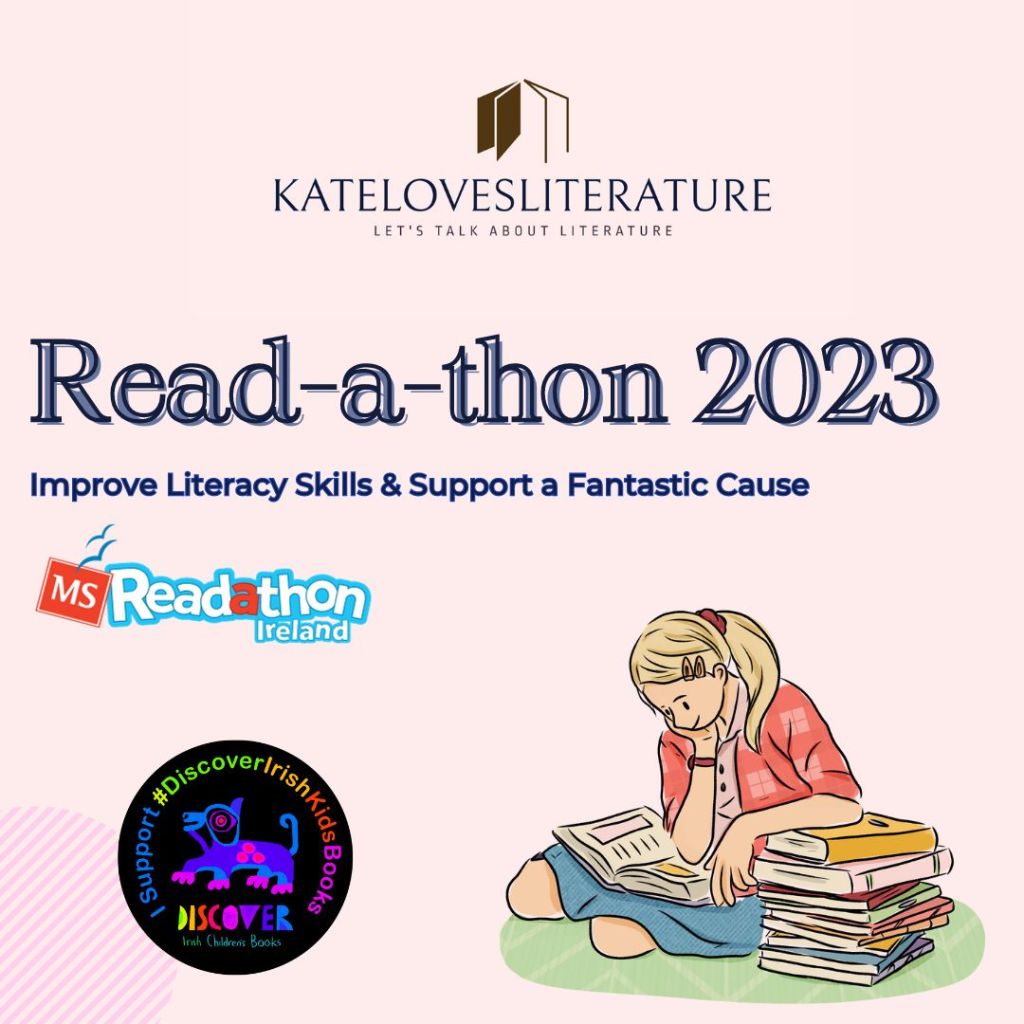
A fabulous family member of mine reached out and asked me to share this brilliant book event. Not only is it for a fantastic cause, but it is a simple fundraiser that will hopefully inspire young readers to pick up more books and expand their literacy skills. Adults can join in too!
The MS Readathon is an annual event that is run by the MS Societies in Australia, Ireland, and the USA. It is held every year during the month of November and according to the website, nearly 7,000 people are taking part already. That is a lot of books!
I love how much freedom the kids have. They can choose any book they like. Picturebooks, comics, graphic novels, fiction, non-fiction … there are no limitations! The aim of this event is to get people reading as many books as possible.
An event like this is a win win for everyone. Participants will not only improve their reading skills by reading more frequently, but hopefully they will develop a deeper love of reading too, and they will be raising money to help support people who are living with MS.
There are many ways to fundraise, the different options are outlined on the website.
I highly encourage you to get involved if you can. Everything counts, be it on a larger scale or a smaller one.
When we all work together and do a little something, we can collectively make a big difference.
As a #discoveririshchildrensbooks champion, this is also a great opportunity to highlight how a readathon is a great opportunity to pick up as many Irish children’s books as possible. We have some incredible authors, illustrators, and storytellers right here on our doorstep. You just may find a new favourite book!
Be sure to follow me on Instagram if you don’t already @katelovesliteraure for all updates about what is #comingupsoon
I’ll be sharing all Readathon Updates on Instagram so be sure to tune in.
A dark and sensual story, set in an old castle in a dark forest, always sitting under dreary, grey skies.
What could be a better October read?
Young Laura lives with her retired father in the Styria forest. All is picturesque until an unknown house guest arrives. Carmilla is myserteous and beautiful. She spends most of the day asleep and her moods can be unpredictable. It appears that she and Laura have met before, in a dream that Laura had as a child. But was it really a dream?
Not long after Carmilla’s arrival, young girls who live near the castle have started to die, seemingly from unknown causes.
The story goes on, narrated by Laura, we follow her first-person account of what it was like being in a vampire’s gaze. Each page is filled with desire and dread, and dark secrets eventually emerge.
It was interesting going into this book knowing that Carmilla is a vampire. Despite never having read the book before, I knew that it was an early work of vampire fiction, and I knew that the story predated Dracula, so I feel that perhaps some of the suspense was dampened. I’m sure it would have been thrilling to read this book when it was first published, when vampire traits were not so culturally established. The mystery of Carmilla’s character would have been heightened if I didn’t know anything about her before reading.
This didn’t hinder my enjoyment of the book, it is just a thought I had when preparing to write down my thoughts.
There are many roads that one could go down when discussing Carmilla.
The book dives into important key themes such as sexuality, specifically female sexuality as Le Fanu presents a sapphic relationship to readers in a way that is extremely straightforward for the time that this work was published in. I would argue that vampires have an established reputation as being very sensual figures, and I think that you can see this trope being carved out in Carmilla because the act of draining someone’s blood is presented as an act that always combines pain and pleasure. Carmilla chooses beautiful young women to prey on and she enjoys biting their necks and sucking their blood, and Laura in particular, enjoys the feelings even though she is sometimes unnerved. The other major theme that this book presents is the idea of extreme class divides.
Le Fanu takes the idea of the rich “feeding off the poor,” to a literal place.
I want to talk about the character of Carmilla specifically, because in so many ways she is a significant literary figure that represents so much power, but she is also a villain. I found this duality the most interesting when I was reading the book.
When you consider the gender roles and the strict societal rules of the 19th century, it is easy to look at Carmilla and identify her as a female character who defies the patriarchy. Due to her immortality, she is powerful all by herself. She comes from an aristocratic background yet she did not have to marry or have children or continue any sort of bloodline. (Pardon the pun). She uses her attractiveness to her advantage. People, (men) welcome her into their homes because of her status and because of her beauty, and she is able to take advantage of the fact that people do not see her as a threat. She is also completely unapologetic about her sexuality. There is nothing repressed about her sensual acts or her expressions of desire.
In ways she reminds me of Milady de Winter in The Three Musketeers, yet Carmilla displays absolutely no concern towards the poor. In fact, she sees them as simply meals. She goes as far as scolding Laura for showing empathy at the funeral of a peasant girl who died due to an “unknown illness.” Carmilla states that she doesn’t concern herself with “peasants.”
There is a disconnected attitude displayed towards the poor in general in the novella. Laura and her father describe themselves as “middle-class,” yet it is clear that they live a luxurious life in their castle. They also do not worry at all about the mysterious illness that is killing young girls, because even though they do show some sympathy towards those girls, they never see themselves as being under any threat. They view the mysterious disease as an illness that peasants simply spread among themselves. This disconnected attitude highlights how privilege creates bubbles for people to live in. Laura is not as vicious as Carmilla, who views herself as superior due to her aristocratic lineage, but she does recognise that her father’s position protects her in many ways. Carmilla’s comments at the poor girl’s funeral appear even more callous when you learn that it is she who is feeding on those young girls. There is also the implication that people were not too concerned about whatever was plaguing the villages until Laura started displaying symptoms. Now a middle-class girl is unwell, so doctors must try harder.
It is very telling when you see some people’s lives being presented as disposable.
It is important that we stop and ask why that is? It is also a theme that can be found in other works.
In Jekyll and Hyde, the musical, the rich are terrified when Hyde starts murdering people in their social circles, but they are relieved later when he kills Lucy, a prostitute, showing that they don’t mind that there is a vicious murderer still on the loose, as long as he is not targeting them.
If one removes the vampire element for a moment, it is the same when a poor person gets sick in a period piece vs a rich person. The rich person is taken seriously, and often provided with the best care. A poor person may not be able to receive any medical attention at all due to money, and there often isn’t much sympathy given. It is an example of how anyone can get sick, but not everyone can recover in the same manner and this can be due to finances alone. A rich person may arrogantly assume that an illness will not impact them, but if it does, they have a better chance at surviving due to money and care.
I’m a big fan of the supernatural elements of Carmilla. I don’t wish to spoil the ending, but I will say that I enjoyed the ambiguity. The idea that even though a figure has been “beaten,” but they may not be fully gone is always intriguing. This idea suggests that danger could return at any time, so the “safety,” found at the supposedly happy ending is always sitting under threat. I particularly like this because I think it perfectly illustrates that gothic trope of safety being subverted.
I would recommend Carmilla if you have not already read it. It is a great read that is not too long and the suspense builds beautifully. It is a literary classic for a reason. Even if vampire fiction is not usually your cup of tea, it is a dark and engaging tale that will captivate readers, and it is interesting to see early works of vampire fiction before mainstream tropes were commonly established.
Be sure to follow me on Instagram if you don’t already for all updates about katelovesliterature.com
The month of October is one of my favourite months of the year. I am a cliché. I love autumn.
I love seeing the leaves change colour and cover the ground in layers of orange, red, and gold.
I love crisp October days that are filled with blue skies and air that is fresh and cold.
I enjoy #spookyseason. I think October lends itself to creativity. People are embracing the vivid, rich colours of the season. People are discussing some scarier books, some spookier short stories, and we celebrate and discuss the eerie, the spooky, the mysterious. It is fun.
It is not everyone’s cup of tea, but what is?
I’ve been thinking a lot about horror as a genre lately. I’ve always been very honest and I’ve spoken a lot about how I scare easily. I am squeamish. Blood and gore is not for me, however over the last three years, I’ve had a different experience with horror. Before I would avoid it completely, but over the last few years I’ve found that even if there is one or two scenes that I have to look away from, I can still enjoy and appreciate horror. There are some aspects of horror that I do really enjoy.
I’m a fan of gothic literature and there are certain gothic tropes that will always intrigue me.
A great example is how the idea of a safe space is often subverted in gothic literature.
One’s home is often presented to readers and to audiences as the safe space. It is the outside that is scary, however gothic literature tends to subvert this idea. Home becomes the place where the darkness lurks. The place where, in theory, you should be the safest, becomes the place where the danger lies. I’ve always found this concept fascinating. I’ve also always loved the contrast between what is often visually a beautiful house, clashed against the darkness that is happening inside behind the facade.
At this year’s CBI Conference, the theme was Risk and Reward. Obviously horror is a genre that requires characters to take a lot of risks, and there are not always rewards for everyone.
Something that really fascinated me and inspired me to write a discussion piece about horror was something that Amy Clarkin said.
She was speaking about her book What Walks These Halls. Amy was a brilliant speaker. She spoke a lot about her chronic illness and isolation. Something that stood out to me was when she described horror as a safe space. I’m sure others have said this too, but at the time, I almost laughed because it is so ironic. Horror being a safe space, I still think it sounds funny even though I completely understand what she is saying. I have not read What Walks These Halls yet, but it is next on my list.
I am very excited to dive in as I believe it is a ghost story and if you have followed me for a while then you know that I love ghost stories.
Amy’s description of horror as a safe space really inspired me. I’m new to the genre. I am not a lifelong horror fan, so there are many more people who are much more qualified to speak about it than I am, however I’m fascinated by it because I feel like it is similar to children’s literature because of the way it is often dismissed as “just horror.”
Children’s literature is so much more than “just for kids,” and I feel that horror is so much more than “just horror.”
The two things that I’m reflecting on in this discussion piece are the ideas of horror as a way to experience fear in a safe, controlled way, and the ideas of horror being a way for people to express their fears in a way that can be really beneficial for them. Horror as a safe space to discuss what scares us and using horror as almost a coping mechanism or as a comfort are ideas that just intrigue me so much. I want to engage with those ideas and I want to continue to become more familiar with and appreciate horror.
Horror as a Safe Space, Horror as a Teacher.
I am linking this thought to children’s literature because that is my area of study.
When we talk about scarier moments in children’s literature, we talk about the way that fear can benefit kids. It is good for younger readers to experience a scary situation in a safe way through books. It is empowering to see that scary situations can be overcome. I’m always fascinated when I see the idea of happily ever after being criticised as unrealistic, but then scarier moments are also challenged. Happily ever after is not the most realistic concept, sure, but a life with absolutely no scarier moments is also extremely unrealistic. I think there is a need for both. The pure escapism of a happy ending can be lots of fun, and hopefully real life is somewhere in between. Not unrealistic but not full of strife either. Age appropriate scares are very important.
Reading a book that is a bit darker does several things. Firstly, it is a step upwards. It is more challenging, literally and figuratively. Explaining a scary concept or describing danger to a young reader will mean that the author is being quite descriptive and expressive. So the reading level has become more advanced. We’ve taken a step upwards. We’ve also taken a step upwards emotionally, because reading something that may temporarily scare or upset you is how you become a broader reader. How do we expect people to grow up and be moved by literature if they’re never given material that will push and pull on their emotions?
Reading about a scary situation in fiction can also help us develop empathy. Reading in general helps us develop empathy, but reading about fear does so on a more advanced level I think.
When reading, we fear for the character and we worry for the other characters in the book who are also impacted. Something scary happening to someone else allows us to develop empathy for that person, and books can also teach real life lessons too. Be careful with strangers, don’t trust someone you don’t know, don’t do something that feels off or wrong …
One of the greatest lessons I remember learning was how to trust my gut. If a character is describing the feeling of not being sure, of not wanting to do something but feeling pressured, of something feeling not quite right but you can’t say for sure what’s wrong, I remember reading and wishing that the character would just stay put. Just wait. Don’t do that, because that’s dangerous. You don’t know why it is dangerous, but it just is.
Recognising that feeling in books made me more aware in my real life. I became much more aware of my feelings and my surroundings, and if something did not feel right, even if I could not fully explain why, I just didn’t do it.
I definitely believe a bit of fear is needed. Even the most simple of plots need stakes of some kind, otherwise what is the point? Where is the motivation? Fear can be brilliant in many ways. It challenges readers to heighten their reading level, it challenges them emotionally and helps people develop empathy for others. Fear in books can also help readers sharpen their skills in real life, as fear can teach readers lessons about looking out for themselves and others without having to learn the hard way. The more you know, the more power you have. Fear can also be immensely satisfying in books and film, especially if that fear is conquered. There is no better feeling than the happiness and joy that can be found when a protagonist finally conquers their fear. It is a great moment and it shows young readers that we can do hard things and we can conquer fears. It may not be easy, but it also may not be impossible.
Horror as an Escape, Horror as a Form of Expression.
This is an idea that I’m intrigued by and I would love to hear more writers and authors speak about this, but the idea of using horror as a way to deal with something “real,” fascinates me.
Horror as a metaphor is not a new concept, I’m not reinventing the wheel by discussing this, but I do want to highlight the idea because of how it has helped me develop a new appreciation for horror.
One of my favourite books is A Monster Calls by Patrick Ness. In the book, the young protagonist Conor must come to terms with the fact that his mother is dying. In his grief, he is visited by a monster who tells him stories and helps him face his true fear. Conor is truly afraid to admit that he is ready for his mother to die. He has watched her suffer for a long time. He knows she is not getting any better. He wants her to be at peace. He will miss her, but he is ready. He is afraid of admitting this because he is afraid that admitting he is ready for her to die will make him a horrible person. He fears that feeling this way makes him a monster.
This book is incredibly moving. There are so many interpretations. Some say that the monster represents the stages of grief, others say a monster is a great way to articulate grief because a young teen may not be able to express grief clearly. They may just be able to say that they’re scared and monsters are stereotypically scary. The book is ambiguous because it never confirms whether or not the monster is a figment of Conor’s imagination or if he is a real figure who does exist somewhere and he shows up for children when they need him. Regardless of which interpretation you prefer, this book is poignant and so deeply moving.
Patrick Ness expanded on the late Siobhan Dowd’s idea. Some have questioned if perhaps the book was more personal when you consider Dowd’s perspective. Did this story help her face any fears or come to terms with her own diagnosis? I won’t elaborate further on that point as I believe that it was not officially stated by Dowd or Ness that this was the case, however it is a reasonable interpretation.
Grief being the real monster is a popular idea. We see it again in The Babadook, and I believe that John Krasinski stated that for him, A Quiet Place was all about how parents fear for their children and he wanted to explore the lengths that one would go to so they could protect their family.
I’m not an author so it is something that I cannot discuss from personal experience, but I am fascinated by the idea of turning to horror as a genre and using it as a way to express a personal fear.
I love looking at what that personal fear may be, and how it was portrayed in horror, and thinking about why those choices were made. To return to fairy tales, Little Red Riding Hood is a story about being cautious and wary of predators. The predator lurking in the dark, off the beaten track in the story is a wolf and it can function as both a straightforward story and as a metaphor for safety. If you’re alone, be aware of your surroundings. Do not get lured into unknown territory. Stay in public spaces, and always be aware of those lurking in the dark because they may wish you harm. The wolf can be both an actual wolf and the wolf can also represent a predator.
Final Thoughts
Horror is a genre that I have previously taken for granted. It is not “just horror.”
There are many different kinds of horror film or book. Horror can be extremely nuanced and complex. It can also be about the sudden thrill of a jump scare. Horror can be extremely metaphorical and the genre can be used as a lens to teach about fears, but it also can be used to cope with fears. Scares here and there can enhance our reading skills, broaden our horizons, and help us be more informed. If you are easily scared or squeamish like me, but you’re curious, know that there are still ways to enjoy things on the scarier side. You can look away from specific scenes if you need to and I’ve found that reading is much easier than watching a scary film because the visuals can scare me more than just reading about something. I’ve found some spooky short stories that I really love and I’m so glad that I didn’t miss out on them. This could be an option for you too!
Make sure you follow me on Instagram if you don’t already for all updates on what is coming up next on katelovesliterature.com
Spooky, but not too scary picks for younger readers.
A recommend reading list by Kate O’Brien.
There is a certain amount of fun that comes with being scared. With each year that passes I enjoy horror a little bit more, but I’ll be honest, I’ve always been the type to get scared easily.
Despite being somewhat of a self-proclaimed scaredy-cat, I’ve always been fascinated by spooky stories. They draw in readers in such a way that even though there are some scares between the pages, the tales are too good to miss.
For younger readers who want to enjoy spooky season but don’t want anything too scary just yet, starter scares are a brilliant option. What is a starter scare? Let me tell you.
Not every single “scary” book is spine chillingly spooky, some have the perfect balance of humour and mystery mixed in so that younger readers who want a little scare can enjoy the spookier elements without the story being too dark or too much.
There are some films that I would describe as starter scares too, so perhaps I’ll publish a “Not Too Spooky Movies,’ list next week … Stay tuned!
For now, here’s some selected reads that younger readers may enjoy as we get closer to Halloween.
The Goosebumps series by R.L. Stine.
An obvious choice perhaps, but The Goosebumps series has been applauded as the series that paved the way for horror stories for children. These books are relatable for young readers in many ways because the protagonists are always tweens or teens. Despite the stories featuring scarier elements such as the supernatural, each story follows a similar structure, meaning that young readers will experience scary situations through fiction, but they will do so in a familiar, controlled way.
Notably, the books never feature death or violence so even though the characters face spooky situations, they never have to deal with anything too serious. The stakes are age appropriate, and the books are funny too. Ideal for readers aged 8-12.
The Graveyard Book by Neil Gaiman.
This book is a childhood favourite. I remember reading an extract of this book, the first chapter I believe, in primary school when I was ten. Gaiman’s work is a spookier step upwards when you compare it to Stine’s series. For example, in this book a toddler manages to escape the killer who is after him after killing his entire family with a knife. The scenes described in the house are dark and bleak, and they may scare a reader who is more squeamish and sensitive. The boy reaches the graveyard. There he escapes the killer and he is taken in by the ghosts who reside there. This book is more touching than scary even though it does contain some gruesome moments. I’d even go as far as saying it is a coming of age story that is simply set in a graveyard with ghosts, however due to its darker elements and themes, and despite being fascinated with the story when I was ten, I would err on the side of caution and recommend it for readers aged 12+
It is an ideal book for readers who have gotten a taste for scarier stories already and want something a bit more intense as Gaiman’s work steps it up a notch.
Monster Island by Freddie Alexander.
This book is another one for readers aged 8-10. I’ve reviewed it already on katelovesliterature.com
I felt that it deserved another mention because it is an ideal book for spooky season. Freddie Alexander’s book explores what would happen if the monsters under the bed turned out to be real after all. Sam has to contend with moving house, adjusting to life in a new place AND with the scary discovery that monsters are real after all. Can she escape? Read and find out.
Helen O’Higgins has brought the tale to life with vivid, Tim Burton-like illustrations. This book is the ideal mix of scary but fun with some fantastic illustrations that readers are sure to love.
Escape Room by Christopher Edge.
Edge’s novel is definitely another step upwards as it is fast-paced and intense. Edge is a writer who knows how to really fill a plot with lots of information and twists and turns. This is a great book for readers who also love to play games as Edge has a knack for writing puzzles. Twelve – year old Ami finds herself in the ultimate escape room. She and her teammates must find the answer and escape before it is too late. Fast paced, high stakes, and completed with a huge twist, this book is a thrilling read. I’d recommend it to readers aged 12-15. I found this story to be a really creative take on the very popular escape room trend. I love the premise, what if it wasn’t just a game? Read and find out what happens for yourself.
I hope you’ll enjoy this short list of starter scares. I hope you’ll feel inspired to pick up a book.
Let me know if you have a favourite spooky book that you remember reading. What is the first scary book you read? Do you remember? I’d love to know.
Stay tuned as there will be more #spookyseason themed discussions coming up.
Follow me on Instagram @katelovesliterature if you don’t already for all updates about what is coming up next.
Bad Magic: A Skulduggery Pleasant graphic novel by Derek Landy
A review by Kate O’Brien.
Derek Landy fans should look out because a brand new, original graphic novel has just hit the shelves.
Landy has created a stand-alone story about a small Irish town that is haunted by monsters and dark secrets. There is a monster causing havoc. There has been one unexplained death after another, so now Skulduggery Pleasant and Valkyrie Cain have arrived in town to investigate.
They’ll discover that there is not just a monster on the loose, but there are monsters lurking inside many people. With every turn of the page, horror and mystery lures readers further into the bright, vivid, sometimes scary world of Skulduggery Pleasant.
I enjoyed this graphic novel. It was very eye-catching. I am a fan of graphic novels because I am a fan of visual storytelling. I actually really enjoyed seeing this world in this format. I think that more graphic novels from Landy would be welcomed, especially by readers who are just entering into the YA audience.
I really enjoyed the concept and premise. The idea of a monster being fuelled and brought to life by the cruel, hateful things people say was a really interesting, if not completely groundbreaking one. It was an interesting way to highlight how things that some may see as small things build up to become a bigger problem that hurts other people. Landy’s portrayal of prejudice is not the most subtle, he is quite straightforward and obvious in the way he writes about it. I think this makes sense as this graphic novel is aimed at a younger audience. I’m not suggesting that younger readers cannot understand and/or appreciate nuance, however this novel is for readers who are just starting to make their way into the adult world.
I think that older readers may find things a bit too obvious, however I also think that prejudice, sadly, is not a nuanced issue. Sometimes it is. Sometimes there are complex layers to things and we have to disentangle ourselves from prejudices we may have held subconsciously. Other times, sadly, prejudice is loud and obnoxious. Sometimes people will be loud and proud about their hateful views, and I do think it is important for teen readers to see this type of behaviour obviously called out. It is important that prejudice is obviously protested.
Sometimes metaphors have a right to be heavy handed.
I would recommend this novel for readers aged 12-15.
Thank you to HarperCollins Ireland for sending me a review copy.
Please note, this review contains all of my own opinions. It is not an ad, it is not sponsored in any way. It is not paid promotion.
Last weekend I went to see Past Lives in the cinema. It was a great way to spend the afternoon.
This movie just came out, it was released on the 7th of September 2023.
It was directed by Celine Song, and the movie stars Greta Lee and Teo Yoo.
The pair play childhood sweethearts Na Young, (Nora) and Hae Sung.
The movie follows childhood sweethearts, Na Young and Hae Sung as they grow from childhood best friends to adults who must decide what they mean to each other. The movie opens with a childhood romance in South Korea, but the school friends are separated when Na Young and her family immigrate to Canada. The movie then follows the pair as they reconnect later on, then grow apart, and reconnect. The pair find each other over and over again.
This movie has a few key themes. It explores the idea of soulmates, it explores love and the many forms that love can be found in. It explores human connections and how certain people are just drawn to each other for reasons that may seem hard to explain. It also explores the clashing ideas of choices vs fate. The movie highlights the Korean philosophy inyeon, which is an idea and a belief that if people are destined to, they will meet, even if they are miles apart. The movie shares the idea that if two strangers brush past each other and they touch on the street, it was not an accident, it was because they knew each other in a past life. Whether you believe in past lives or not, whether you believe in fate or not, or in the idea of “the one,” or not, the concept is a beautiful one.
I really enjoyed the movie. It was very stylish. The pacing was slow, and warm, it felt intimate.
As an audience member, at times it almost felt like I was intruding on a private, personal conversation, which is a testament to how brilliant these actors were. The movie felt realistic without being cynical. The acting was nuanced, casual, not over the top. I believed these two people were lifelong friends, and maybe more, in another time, in another place.
The movie did have sub-titles as the two main characters speak mostly in Korean, however I personally have no issues with sub-titled movies. I never feel like it is harder to get invested, and in fact, I think it is a beautiful thing that this movie moved me so deeply, and it wasn’t even in my first language. Human connections, relationships, life’s ups and downs, all of these things are deeply understood, sub-titled or not.
This movie was very wholesome. That is the perfect word to describe it in my opinion. It made me laugh, and it made me cry. I really enjoyed the way the story acknowledged story structures and certain expectations but subverted them. Without spoiling anything, what I will say is that the trope of lifelong, childhood sweethearts is a hard one to pull off, especially if the story introduces another love interest, one who does not have the same history.
We expect childhood sweethearts to finally get married when they’re adults. The idea is a lovely one. We root for the couple who have history, who have known each other all of their lives, who have grown up together. We root for them because the idea is comfy. The thought of ending up with someone who knows us so well is a nice thought. It’s easy, but how many actually end up with their first love? We grow up, we grow apart, sometimes by things beyond our control as shown in this movie. Na Young did not want to move, but she was twelve and her family moved so she did too. We change as we grow, and sometimes while we can still love people, we grow out of them. I’m not suggesting that no childhood sweethearts ever make it work, of course there are always exceptions to every rule, but I do believe that the idea is nicer than the reality.
I appreciate the way this movie highlighted the fact that a lot of things in life happen because we make choices. Na Young, now Nora, chose to place distance between herself and Hae Sung again because she was determined to make her life in New York work and her calls, texts, and FaceTimes with Hae Sung were distracting her, and they were becoming a source of sadness since both could not visit the other for a long time, due to work commitments, finances, etc.
In order to focus, she says she wants to take a break from talking.
By doing this, her life changes again, and that change was inevitable.
Past Lives beautifully illustrated the realities of growing up and creating a life for ourselves, and the realities of how we gain and lose people in life in a very realistic way without being cynical.
This movie was an extremely wholesome, enjoyable watch, and I thoroughly enjoyed it.
I would highly recommend it. Sweet, funny, with just the right amount of poignancy, this movie is ideal for a rainy day.
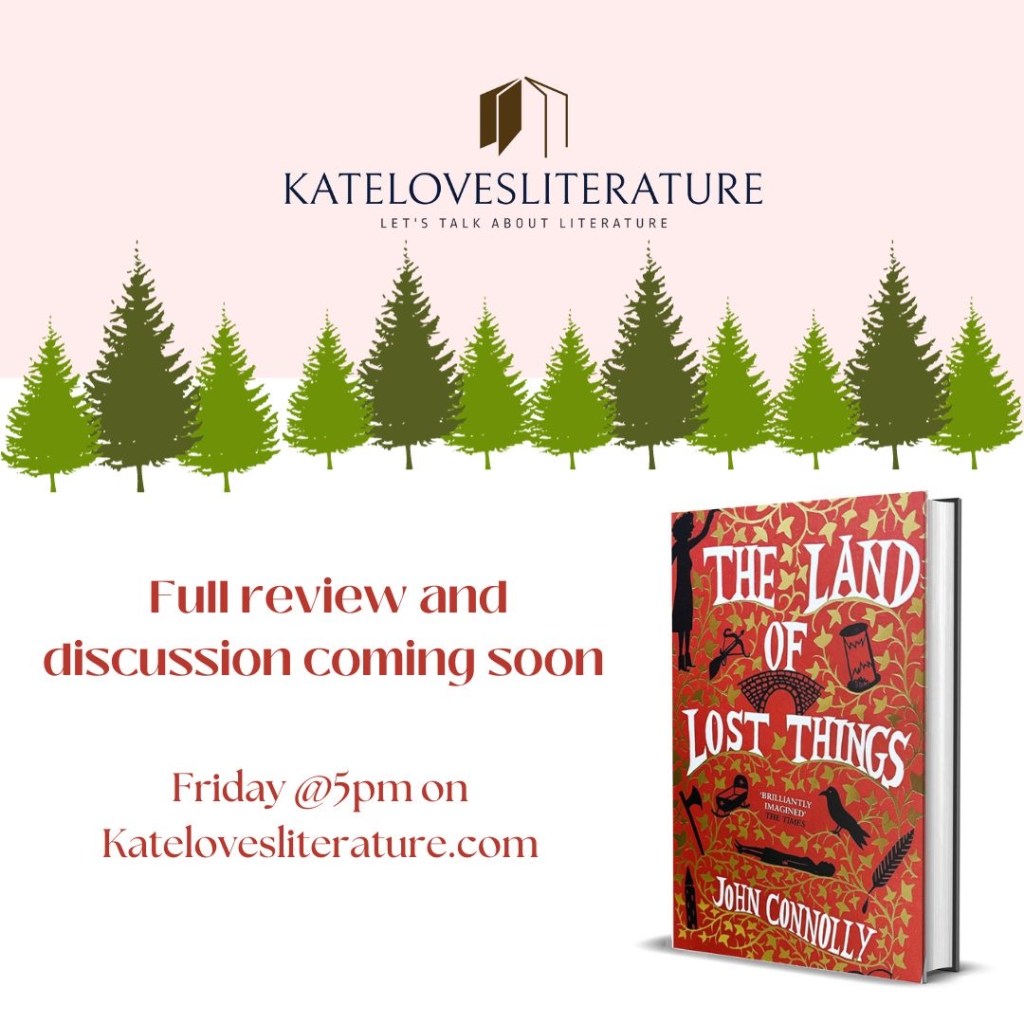
When I read the first of this series, The Book of Lost Things, I said it was a nod to dark and twisted fairy tales, ideal for those who enjoy anything a bit Grimm. (Pardon the pun.)
I eagerly awaited Connolly’s sequel. In fact, I read this entire book in a four-hour sitting.
I was enthralled, happy to read a new tale, and happier again to see old favourites appearing once more.
I’ve taken some time to sit with this sequel, to think about it, to try to answer the famous question of which book do I prefer?
I prefer the original. Predictable, I know, but it is true. The world that John Connolly created in the first book was scary and intriguing. Poignant and emotional. Returning to it was interesting, but without the thrill of the complete unknown.
The Land of Lost Things introduces readers to a new protagonist, this time not a lost child, but the mother of a lost child. Ceres is stuck, her child Phoebe is comatose and has been since the car accident. The bright, curious child she once was is becoming more and more like a distant memory to Ceres, who fears she may never see that lively child again.
I will say now that this book, similar to the first book, contains some very sad and dark themes about sick children, about losing children, and about the grief, fear, and anger that parents carry while trying to stay hopeful. It is a sad read, so not for readers who want some lighthearted escapism.
When Ceres allows her worst fear to be uttered aloud – that perhaps things would be easier if Phoebe was out of pain, she finds herself chased into the same mysterious land that David found himself in when he wanted to escape his new life with his stepmother and stepbrother in the first book.
Ceres finds herself sixteen again and she must face her fears and find her way back home, back to her child, and she does this with the help of familiar faces. The idea of being a teenager again and how horrified Ceres is by this is very funny. It’s a really interesting concept because Ceres is stuck in her teenage body, but she still has all of the knowledge she has gained over the years and as a mother. So she’s almost this ideal that some strive for. Many people wish for the carefree days of their youth back, or perhaps they wish to look as they did when they were younger, but with all of the knowledge of hindsight. Ceres is in this position, yet the idea of placing her back in her teenage body when she is in a fairy tale realm worked really well because the character tells readers that sixteen was her worst year. She hated it. She felt completely insecure, powerless, and vulnerable, and placing her back in that place works really well as it visually mirrors how she feels about the ordeal she is facing with her daughter. Once again she feels angry, scared, and utterly powerless. She cannot do anything for her child aside from hope that one day she’ll wake up, all she can do is hope she is not in any pain.
While I would recommend reading The Book of Lost Things first, it is important to note that this book can be read by itself. Connolly is a very vivid writer, it is clear that he is an avid reader of fairy tales, and he understands the way that they can leave a lasting impact on readers. There are certain stories that we carry with us for life. They can bring us an escape and they can bring us hope and wonder in times when we need them to do that for us. In this story, Connolly expresses an appreciation and a love for literature. The importance of literature is a key theme alongside the bleaker themes of fear and grief. Books can go out of print, but they can’t be forgotten if they’ve been read, if someone is talking about them. Books live on in so many ways, and as Connolly rightly states, “It’s not the people who read books you have to worry about, but the people who don’t.”
I believe that I said the same thing about The Book of Lost Things, but the same applies for this book, ultimately it is a quest. At its core, this story is a quest, almost an epic quest I’d argue as Ceres must journey across a new realm, facing fears and facing dangers, all in order to achieve her ultimate goal, which is of course to find her way home to her child.
In terms of writing style, Connolly is very descriptive, very vivid, and almost cinematic in the way he paints pictures with his words. The story moves at a fast pace and it is full of information, in fact at times there is almost too much going on, but that tends to happen when stories are set in fantasy worlds. Connolly is also fond of ending chapters with a cliffhanger, so be prepared to be in suspense for a while when reading. Without spoiling the ending of this book, I will say that I preferred how the first book ended. It felt more complete than this ending. That is due to the fact that David’s arc ends very differently, we are given a lot of closure as readers about David’s arc, whereas in this book, Connolly leaves readers with an unknown, although it is a hopeful unknown.
The ending suits the book perfectly. The tone and how it all ends is very apt, and the way the story ends is the entire point of the book, but I will argue that David’s arc and his ending with more information makes for a more satisfying end.
Warning – Spoiler – Skip This Section If You Do Not Want To Know The Ending
The book ends with Ceres returning to her daughter after chasing Lady Death, who was hovering over her away. Ceres is scared, she does not know if things will be okay, but she has hope, and she does not want to give up her hope. She begins reading to Phoebe, and after months of no signs of anything at all, the book ends with Ceres feeling one of her fingers moving.
That’s it. We don’t get anymore information. We don’t know if Phoebe will be okay. We don’t know if she’ll make it after everything that Ceres has been through. People critique “fairy tale endings,” and “happily ever afters.” Perhaps it would have been too obvious if Phoebe woke up at the end. The fact that we are left with a small sign of hope but also with uncertainty very beautifully makes the point that Connolly has been setting up throughout the entire book. Sometimes all we have is hope, and hope is worth holding on to. The ending makes sense and fits the overall tone that Connolly has created, but personally I enjoy endings that feel more complete. I’d have been happier if the book had have ended with her eyes opening and that’s it. No big reunion, no dialogue shared, just her eyes opening before the end. A small finger movement is a hopeful sign, and perhaps Phoebe went on to be okay, that’s up to us readers to imagine.
Spoilers Over.
For fairy tale lovers, for readers who enjoy fantasy and adventure, The Land of Lost Things is a must read. There are some wonderful classic fairy tale references that readers with keen eyes will be delighted to spot! For those who love stories that are on the darker side, this book is for you as Connolly is not afraid to lean into the dark and grim.
I am very excited to be writing about another #theatretrip!
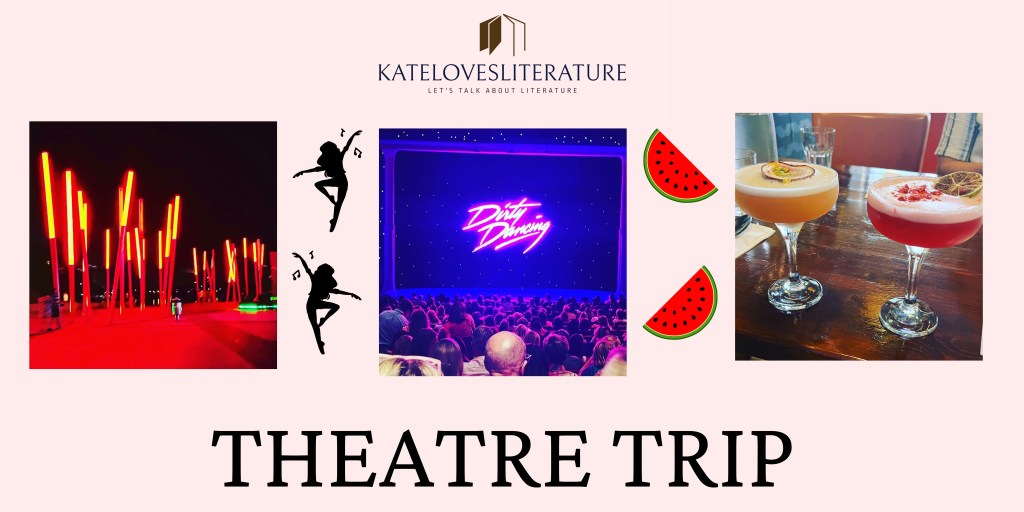
As always, I had an amazing time at the Bord Gáis Energy Theatre.
Last week we went to see the incredible Dirty Dancing live on stage and it did not disappoint. As fans of the movie we were very excited to see the story brought to life. This show is a treat.
In many ways it is an interesting show to go and see due to it being a live retelling of an iconic movie, this show and others like it, attract a very enthusiastic audience. I won’t go into too much detail on this point now because it is irrelevant to a theatre trip discussion and it is also irrelevant to how fantastic the show is, but in terms of audience discussions, it is fascinating to reflect on how some of the more serious, social commentary scenes come either directly before or after sexier moments on stage. These heavier moments that give weight to both the show and the movie clash directly with cheers from the audience because Baby and Johnny are finally having their big romantic scene and it is a scene that everyone has been waiting for.
In terms of pacing, when watching the movie, I’ve always wished that at least a day had passed in between Penny’s tragic and terrifying abortion gone wrong scene and Johnny and Baby’s intimate scene, just because the switch from being so terrified about Penny’s health to watching two characters finally come together romantically at last after the build-up between them has always felt a bit odd. I feel this pacing is odd on stage too. I understand the logic behind it. Baby is comforting Johnny, apologising for her father’s rudeness to him, Johnny is telling her how much he admires her and the scene builds to Baby confessing her feelings for him. She’s afraid she’ll never feel so deeply for anyone ever again. So I do understand how the scene comes to play out as it does, I do just wish that there had been some space between that scene and the terrifying scene that comes before it. The scene before is such a crucial moment for Penny’s arc and I always wish we had been allowed to sit with it for a while longer, but that is a personal opinion, and although I do have some thoughts about the pacing, that has nothing to do with the phenomenal job that the cast did.
Michael O’Reilly plays Johnny. The rugged and charismatic dance teacher whom we all adore. Michael is a true leading man, he commands attention and applause in every scene he is in. I think he perfectly balanced portraying Johnny in a way that felt familiar and true to the movie, without doing a total Swayze impression. I detected a southern accent, if I’m not mistaken, and I thought that he did an incredible job throughout the show. He is clearly a fantastic dancer, and he quite obviously endeared himself to an entire Dublin audience because the cheers that erupted when he returned for his big moment were electric!
I also thoroughly enjoyed how he waited for the cheering to quiet down (which involved audience shushing too) to deliver his iconic line “Nobody puts Baby in a corner!”
Kira Malou was charming as Baby. Again, she embodied some of the iconic moments from the movie without being a caricature. Her personal and sexual awakening felt very organic and natural. It is a real treat seeing Baby come into her own as the show progresses. At its core, Dirty Dancing is a coming of age story. Baby comes of age. She becomes her own person, she realises that her father is not always right about everything. She falls in love, she learns that she has strong opinions about things and how sometimes she will disagree with things she has been taught and that is okay. It is an empowering story about a young woman who finds her voice and loudly uses it. In fact she expresses herself with her entire body through the art of dance and Kira Malou was absolutely fantastic in the role.
Georgia Aspinall dazzled as Penny. Penny is one of my favourite characters. Her arc is so crucial to the entire plot. Georgia was both fiery and very endearing, and of course she was an incredible dancer. Penny is such a complex part. She is scared, she is both hurt by and angry at Robbie. In the beginning she is hostile towards Baby and you can’t blame her for that, and then she is completely appreciative of the lengths that Baby goes to in order to help her. It is a rollercoaster of a part but Georgia’s performance always felt very genuine. One of my favourite scenes takes place during the “Hungry Eyes” training sequence. I love the moment when Penny dances with Baby and Johnny. She gives her the high heels, she helps her with the sexier dance moves. Penny really helps Baby come into her own and embrace her sexual side. It is so lovely to see two female characters who could not be more different find common ground and support each other.
The rest of the cast was incredible too. Each of the ensemble scenes, where everyone bursts onto the stage and begins to dance, were fantastic. The stage was filled with passion and talent. You truly feel like you’re in the staff dance house when you’re watching from the audience. Everyone is working together but doing different moves. Lifts here, spins there, everywhere you look there is something amazing happening, all set to some iconic music. Bravo to the cast, crew, and to the staff at Bord Gáis Energy Theatre.
Dirty Dancing live on stage is a treat for movie lovers and theatre lovers alike.
It is a show that is buzzing with energy, passion, love, and underneath all of that, the show is grounded by some key themes surrounding coming of age and social issues. If you get the opportunity to see this show, don’t miss it!
Be sure to follow me on Instagram @katelovesliterature if you don’t already for all updates about what is #comingup on Katelovesliterature.com
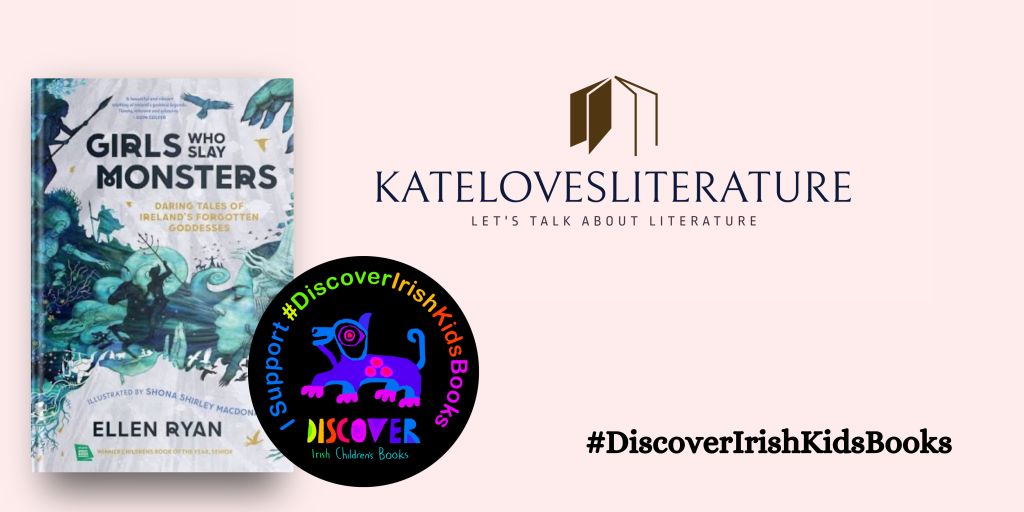
I once read that Ellen Ryan’s Girls Who Slay Monsters was like coming home.
I can’t help but agree. As a woman who is very proud of being born and bred in Dublin, I loved seeing Irish mythology being brought to life in such a beautiful way. This book features twenty-four different Celtic goddesses, and each story is accompanied by detailed illustrations and fun facts about the particular goddess or story setting in question.
Ellen Ryan’s passion for Irish mythology is evident with every turn of the page.
In my opinion, Girls Who Slay Monsters is a gem of a YA book because Ryan’s writing perfectly masters the dance of not being too simple so older readers will be thoroughly engaged, but she also introduces Irish mythology in a way that is easily accessible for readers on the younger side, or for any readers who are unfamiliar with these impressive figures.
Ireland’s goddesses were powerful figures. Warriors, scholars, lovers, artists, and inventors.
These powerful women lived layered, full lives, and it is fantastic seeing their stories told with such love. Ryan’s writing style is quite modern as she steps away from old clichés. Her stories put female strength at the forefront in every tale, and as we are all learning all the time these days, strengths come in many different forms.
As I was reading Girls Who Slay Monsters, a particular idea stood out to me.
As I was diving into Ryan’s mythological world, I was struck by just how timeless these goddesses truly are. It might seem unbelievable to suggest that one can relate to or connect to figures from thousands of years ago, but I think the best kind of literature connects us through the ages. We still revere Shakespeare because even though his works are from centuries ago, at their core, so many of his works discuss the human condition. Feelings fuel so many of his plays. It is interesting how nobody bats an eyelid when we talk about the timelessness of someone like Shakespeare, but the same attention is often not given to figures of Irish mythology.
Ryan brings goddesses who have been forgotten or downplayed to the surface in her work.
Girls Who Slay Monsters tells stories of women who were of different shapes and sizes, each with their own unique interests and talents. The most shocking thing is that so many of us likely have not heard of these goddesses before! It is stark and disappointing when I took note of just how many of these stories that I never heard about in school.
Ryan’s work is accompanied by illustrations by Shona Shirley MacDonald.
Her illustrations are a stylish combination of blues and greens, occasionally interrupted by vibrant pops and clashes of vivid oranges and reds. The images really take readers into the world that Ryan has so lovingly created, and younger readers especially could be taken in by the images first, but then find themselves thoroughly wrapped up in the stories.
Picking a favourite story from this book is almost impossible, but I must say that the story Lí Ban Immortal Mermaid stands out to me each time I read it. It is a moving tale about Lí Ban, princess of Ulster, and how she finds her way back to her father. It is a tale of love, bravery, and of two people being separated and reunited. This line stands out starkly as Ellen has such a beautiful way with words, this line in particular is almost melodic. “All she could hear was the beat of her own heart.” (Pg. 54)
I am really looking forward to Ryan’s next book Gods Don’t Cry. I look forward to seeing her take on the many different forms of masculinity. There are many different ways to be strong, just as there are many forms of intelligence, and men are just as layered and complex as women. I think she will present another beautiful book, one that tells various stories about some incredible Irish gods, and I look forward to seeing their stories told with as much love, care, and attention to detail that was so evident in Girls Who Slay Monsters. I am also really looking forward to seeing Conor Merriman’s illustrations. The snippets I’ve had the pleasure of seeing already are so striking. I’m excited to see how he brings the entire book to life.
I suspect that Ellen Ryan’s next book will be just as successful as her first one. I really wanted to read Girls Who Slay Monsters as I had heard such brilliant reviews from friends, and other reviewers, and of course Ellen Ryan got some extremely well-deserved accolades for this work. The 2023 CBI Awards come to mind. I was in the audience that day, and I had the privilege of meeting Ellen at an event for Gods Don’t Cry, so I am aware that I run the risk of appearing biased, but seeing her joy at discovering just how many young readers loved Girls Who Slay Monsters at the CBI awards, and hearing her enthusiasm, her excitement, and her passion for all of the work she is doing and has done as the launch of Gods Don’t Cry draws nearer has been wonderful. I love meeting creative and passionate people. I love hearing someone talk about the things they love. I love seeing someone succeed when it is obvious that so much work and care went into what they do.
As a reviewer, and as someone who has always found a sense of comfort in literature and in the arts, I think that it is fair to say that often, literary works are passionately received. Audiences and readers love to love books. They love to find themselves immersed in new worlds, falling in love with new characters. That is why books mean so much to people. When it is clear that books are passionately received, it is a real treat to be able to immediately recognise when a story has been passionately told. Girls Who Slay Monsters is a collection of unique, engaging, page turning stories that Ellen Ryan has passionately told. There are a few tweaks here and there to some of the legends, but really what Ryan has done is remarkable. She has given a voice to figures who were previously silent, whose stories were at risk of never being told, especially when you consider how often female stories are told in a way that just acts as a side note to a man’s narrative. Ellen Ryan has made the goddesses the leads in their own stories.
I would recommend Girls Who Slay Monsters to all young readers, but especially to young girls who are between the ages of ten and thirteen. Full disclosure, I think any adult who loves mythology, action, and adventure will love this book too so readers of any age should feel inspired to dive into this book. That being said, I think that this is an important book for young girls who are right on the cusp of maturity. For those who are trying to find their own voices, and their own independence, for those who are starting to carve out their own path, I think Ellen Ryan’s words will impact those readers the most. I think that age group, and those who are currently experiencing that journey into maturity will find comfort and inspiration in Girls Who Slay Monsters.
Be sure to follow me on Instagram @katelovesliterature if you don’t already for updates on everything regarding Katelovesliterature.com
Ireland has an incredibly rich literary history. Ireland is home to legendary writers such as James Joyce, Oscar Wilde, Bram Stoker, and many more who have made it into the pages of our history books due to their incredible talent with words.
Today, Ireland is still home to some extremely talented contemporary writers such as Anne Enright, Sally Rooney, Eoin Colfer, Sarah Webb, Ellen Ryan, and many, many more. Not to mention the abundance of wonderful Irish illustrators. We are a country overflowing with creative talent.
The fact that we are home to fantastic writers, illustrators, and booksellers makes it all the more disappointing to learn that Irish books are just not receiving the visibility they deserve.
In a recent article in The Irish Times, Fiona Gartland highlighted the concerns being raised by children’s author Sarah Webb and many others about how Irish books are being left behind due to many factors, one of them being that many books do not receive the same attention and promotion as books that come with big celebrity names attached to them.
Sarah Webb recently took to social media to share that she noticed there hadn’t been an Irish writer or illustrator in the Irish top 10 for over 20 weeks. This is a real shame as there are so many wonderful books that children are missing out on.
The ironic thing is, as noted in Gartland’s article, when children are given Irish books, they fall in love with them. Our Irish authors can hold their own.
What can we do to promote Irish authors?
Author Sarah Webb has created the Discover Irish Children’s Books campaign. You can lean more and discover how to get involved by visiting the website https://discoveririshkidsbooks.ie/about/
The aim of this campaign is to bring Irish children’s books and their authors and illustrators to the attention of young readers and adults.
This campaign is needed because many children living in Ireland cannot name any children’s authors who are Irish or living in Ireland. Very few Irish books are appearing in festivals in Ireland. This does not make any sense. Books written by Irish authors should absolutely be given attention in Irish literary festivals and at Irish literary events. We should be able to showcase and celebrate the amazing talent we have on our doorstep.
It is a terrible shame that Irish children’s books are hardly appearing in Irish children’s bestseller lists.
There are so many steps that can be taken to help balance the scales so that Irish books are not being so massively overlooked.
We need to spotlight them at our literary events. Bookshops need to showcase them in their stores. In classrooms, teachers and/or school librarians need to pay attention to the amazing Irish works at their fingertips and bring these books into their classes so kids can see them, read them, talk about them, and get excited about them. Unfortunately when we are young, the books we read are behind gatekeepers. When we are little, our books are bought for us, shown to us, and if we are never shown certain books then we don’t ever get the opportunity to love them.
Adults buying books for their children, grandchildren, nephews, nieces, children of friends … whoever we may be buying books for, we have a responsibility and an incredible opportunity to expand the horizons of the young readers in our lives.
As a literary reviewer, and as a book lover in general, I am going to make a very conscious decision to make sure that I highlight Irish books on Katelovesliterature.com. I am from Dublin, I’m very proud to be Irish, and even though I have featured Irish writers frequently on my platforms, I still believe that I could do even more.
I want to be a Discover Irish Children’s Books champion, I want to give recommendations about wonderful books that I think young people would really enjoy, and I want to share and celebrate Irish talent and creativity.
This campaign is not about ignoring other books or talking about giving young readers Irish books only, but it is about ensuring that Irish books have a seat at the table. It is about ensuring that we are not missing out on or overlooking some amazing stories.
I do not just discuss books. I will continue to review and discuss films, poems, theatre, and theory and literary events and literary inspired trips as I always have. I will continue to ensure that I discuss a broad range of literature, but I will be creating a list of Irish book recommendations and I will be continuously adding to that list so that when readers visit Katelovesliterature.com, not only will they find a wide rage of topics to read about, but they will also find a curated list of Irish book recommendations that I hope they will be inspired by, and I hope that they will come across new books that they will really enjoy.



 Katelovesliterature.com